Sunday Post: The Elements of the Perfect British Pub
This week, we explore that great British institution of the local pub and what elements make a good one.
Member Update
Welcome to all the new members who have joined during our free book promotion. We hope you find your membership enjoyable!
We've started some new threads over on the Anglotopia forum to inject some new conversations into it! Come on over and join the conversation! Here are the highlights:
- Your Favorite Pub of All Time
- Pressure - New D-Day Film
- Harry Potter TV Show First Trailer
- H is for Hawk Reaction/Review
- Your Thoughts on the New Forsyte Saga on PBS?
Sunday Post: The Elements of the Perfect British Pub
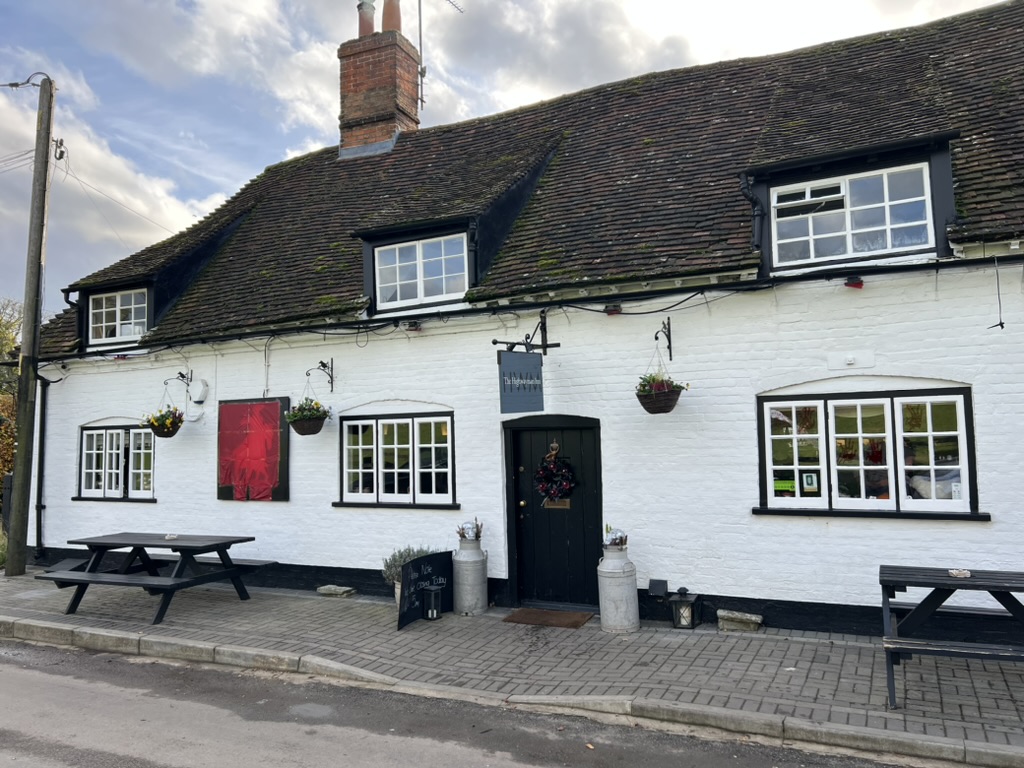
I'm a bit of a man of contradictions. I don't drink alcohol — ever. But I absolutely love British pubs. There is plenty of enjoyment to be had in a British pub, even if you're nursing a Sprite all afternoon, as I do, and I say this as someone who has spent a considerable number of hours doing exactly that. (I suppose it's even more fun if you do drink, but that's well outside the scope of this article.)
Over twenty-five years of traveling to Britain and visiting more pubs than I could possibly count, I've developed my own criteria — my own personal checklist, if you will — for what separates a truly great pub from one that's merely fine. Mrs. Anglotopia and I have walked into some spectacular ones, and we've walked into some that had us back out the door in under a minute. Here's what I've learned.
It Should Be in the Country
Now, I'm not saying you can't have a great time in a pub in London, Edinburgh, or any other city. You absolutely can. But in my experience, the best pubs — the ones that stay with you, the ones I find myself thinking about months later when I'm back home in Indiana — are almost always out in the countryside somewhere.
They tend to be tucked at the end of a village high street, or sitting alone at a crossroads with no obvious reason to exist except that they've been there for four hundred years and the locals aren't about to let them go anywhere. They're near famous walking routes, or they're not near anything much at all. There's a car park that's half gravel and half mud and a hand-painted sign that's slightly crooked. You pull up and immediately feel like you've found something. That feeling is rarely wrong.
The countryside pub also tends to attract a certain kind of clientele — actual locals, actual regulars, people who walked over from the farm or drove in from the next village because this is their pub and has been for thirty years. That energy is irreplaceable.
It Shouldn't Be a Chain Pub
This is getting harder and harder to guarantee every year, and it's one of my genuine frustrations with the British pub landscape. The vast majority of pubs in Britain are either owned outright by large brewery conglomerates or operated as part of branded hospitality chains. The Wetherspoons of the world have their place (one of the biggest pub chains), I suppose, but that place is not on my perfect pub list.
The best pubs, consistently and without exception in my experience, are the ones that are still independently owned and operated. Even if they're tied to a specific local brewer — and many of the best ones are — they have a personality that belongs to them and the family or couple running them. The menu is handwritten on a chalkboard. The landlord knows the names of half the people in the room. Someone's grandmother made the curtains. That's what you're looking for.
When you walk into a pub, and it feels like it could be anywhere, it's almost certainly owned by someone who isn't there.
I should add that there can be 'good' chain pubs - Green King pubs are usually pretty good.
It Should Be Old
I mean genuinely, properly old — not "renovated in 2019 to look old" old. I want low ceilings with exposed beams that someone tall will absolutely crack their head on. I want walls that are slightly uneven because the building has been settling for six centuries. I want a floor that isn't quite level. I want the sense that this building has absorbed an almost incomprehensible amount of human experience — births celebrated, deaths mourned, deals struck, arguments started and finished, and countless ordinary Tuesday evenings that nobody will ever write about but that mattered to the people living them.
Britain is extraordinary at this. You can sit in a pub that has been continuously operating since the 1400s and order a Coke and a packet of crisps, and nobody thinks anything of it. That quiet continuity with the past is one of the things I love most about Britain, and the old pub is one of its finest expressions.
It Should Have Flagstone Floors
This is non-negotiable for me. A proper flagstone floor — worn smooth and slightly uneven from centuries of boots — is one of the most satisfying things in the world to walk across. It sounds like a small detail, and maybe it is, but it sets the tone for everything else. It says: this building was here before carpeting existed, and it's going to be here long after whatever comes next.
Carpet in a pub is a red flag, full stop. I don't care how nice the carpet is.
It Should Have a Dog or Two
Preferably a large, elderly Labrador who is completely indifferent to your presence and has claimed the best spot by the fire as a matter of ancestral right. The dog should be named something like Bramble or Biscuit or Colonel. It should accept the occasional pat with dignified tolerance and then go back to sleep.
A pub dog is a sign of a good pub in the same way that a cat in a bookshop is a sign of a good bookshop. I'm not sure I can fully explain the logic, but I believe it completely.
It Should Have a Fireplace That's Going Even in the Summer
Britain being Britain, this is not as absurd as it sounds. Even in July, a cool evening in the Cotswolds or the Yorkshire Dales can put a genuine chill in the air, and there is nothing — nothing — quite like the sight of a fire going in a stone hearth when you come in from outside.
The fireplace should be the real thing: a proper inglenook if at all possible, with actual logs, actual smoke, actual warmth radiating into the room. Gas fires are acceptable. An electric "flame effect" situation is not. The fire should be the center of gravity of the room, the thing everything else is arranged around, and on a cold or damp evening (which, again, could be any evening), it should be the first thing you notice when you walk in.
I once sat by a fire in a pub in Wiltshire on a rainy August afternoon, and I have never felt more at peace in my life.
It Should Do Sunday Roast
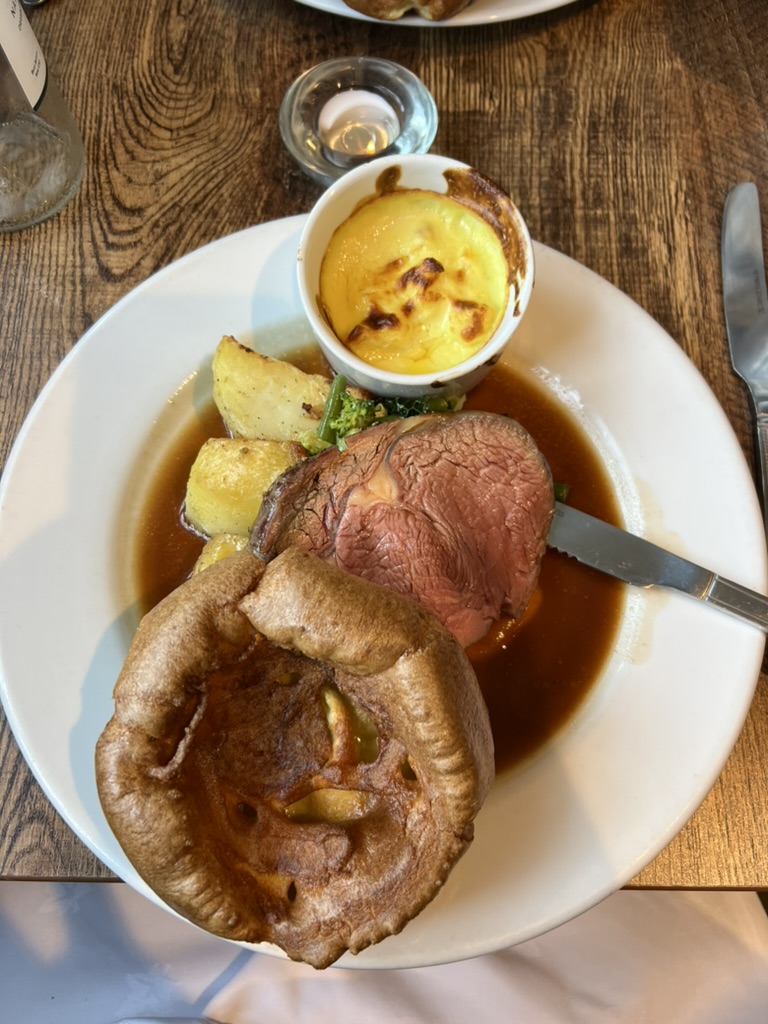
Not just any Sunday roast, though. I want the Sunday roast that requires a reservation. The Sunday roast, where they post on their Facebook page on Friday that tables are almost gone, and you feel a mild panic if you haven't booked. The Sunday roast, where the beef has been going since early morning, and the Yorkshire puddings are the size of your head, and they take it as a personal affront if you don't have seconds.
The reservation requirement is important — it's a quality signal. It means the pub takes its roast seriously, that the kitchen is doing real cooking and not just heating things up, and that the locals already know how good it is. If you can walk in off the street on a Sunday afternoon and sit down immediately with no prior booking, manage your expectations accordingly.
It absolutely should not be a carvery buffet. We made this mistake once and ended up with food poisoning! The White Hart (I didn't have to single out which one, there are several hundred) will forever live in our trip infamy memory...
We have had Sunday roasts in Britain that I still think about years later. There's a particular one in a village pub in Wiltshire that set a standard I've been comparing everything else to ever since. I won't name it here because I don't want it to get any more popular than it already is. (You're welcome, landlord.)
It Should Do Proper Pub Grub
The Sunday roast gets its own section because it deserves one, but a truly great pub shouldn't be a one-trick pony. The rest of the menu matters too, and what I want to see on it is exactly what has always been on it: bangers and mash, steak and ale pie, fish and chips, roast chicken, maybe a ploughman's lunch if you're lucky. Simple, honest, unfussy British food done well. All the meat should be local (and the farmer should be having a drink at the bar with his dog). Not a fifteen-ingredient reimagining of a classic dish. Not a "deconstructed" anything. Just the thing itself, made properly, with good ingredients, by someone who actually cares.
I am particularly — some might say unreasonably — passionate about the chips. Chunky chips. Proper ones. The kind that are crisp on the outside and fluffy on the inside, and arrive in a little metal bucket or piled high on the plate in a way that suggests abundance and generosity and a complete indifference to current dietary trends. Not skinny fries. Not shoestring anything. Not oven chips that have been sitting under a heat lamp since half past eleven. Proper. Chunky. Chips.
I have a theory — unscientific but sincerely held — that you can judge an entire pub kitchen by its chips alone. Get the chips right, and the rest of the menu will almost certainly follow. Get them wrong, and I don't care how good the pie smells, something has gone fundamentally sideways in that kitchen. The chips are the canary in the coal mine. They are non-negotiable. A pub that can't produce a proper chip doesn't fully deserve to exist, and I will die on this hill — preferably with a pint of Sprite and a basket of excellent chunky chips beside me.
It Should Have Friends
This is the most important one, and it took me a while to fully understand it.
All of the other things on this list — the flagstones, the fire, the dog, the age, the Sunday roast — those things create an atmosphere. They give you the setting. But the thing that truly elevates a pub from a place you visited to a memory you carry around forever is the people you share it with.
Over the years, Mrs. Anglotopia and I have been lucky enough to make real friends in Britain — people we met through Anglotopia, or through shared interests, or simply through the serendipity of sitting near someone interesting and starting a conversation. Some of our best memories from our trips aren't the famous landmarks or the carefully planned itineraries. They're the afternoons in a pub somewhere, meeting up with friends we only get to see once or twice a year, catching up over a meal or a drink, laughing at things I can't even fully remember now but that felt, in the moment, like exactly what life is supposed to feel like.
A pub, at its core, is a community space. It exists to gather people together. All the architecture and the atmosphere and the food are in service of that fundamental purpose. The perfect pub is the one where you are surrounded by people you genuinely want to be with — and where, for a few hours, the rest of the world can wait.
Have a pub that meets all (or most) of these criteria? We'd love to hear about it — drop us a note or share it in the Friends of Anglotopia Club forum. Mrs. Anglotopia and I are always adding to the list.
Post a reply