Sunday Post: Life Growing Up Near Hadrian's Wall
This week, we have a special feature article from regular Anglotopia contributor Toni Hargis, who writes a monthly column for us called Brit Buzz (read her lovely and funny articles here). Toni actually grew up in Newcastle in the shadow of Hadrian's Wall, so in anticipation of my upcoming walk, she kindly agreed to write up an article about what that was like for Friends of Anglotopia Members. Thank you, Toni!
Member Update
Welcome to all the new members who are joining this week during our spring promotion - let's give them all a big Anglotopia welcome! This weekly email is the biggest benefit of being a member of our little club, you get a lovely article about Britain in your inbox every Sunday that you can't read anywhere else.
Here are also some highlights from our private discussion forum (that you get exclusive access to as a member!).
- First Look at Young Sherlock Holmes - New Guy Ritchie Series
- Don’t Forget to Get your UK ETA - NEW DEADLINE!
- I’ve Started a Doctor Who Rewatch - Want to Join Me?
- Trailer Released for Grantchester Season 10
- Britain in 2026? Who’s Going?
Sunday Post: Life Growing Up Near Hadrian's Wall
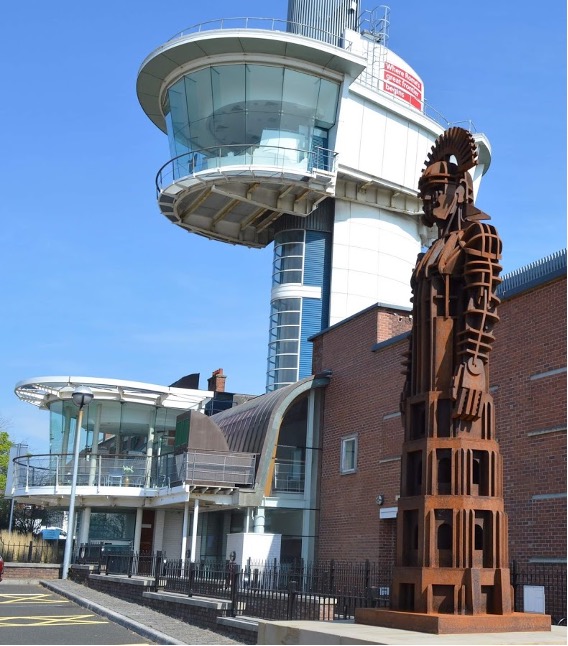
Reading about Jonathan’s preparations for his walk along Hadrian’s Wall this summer takes me right back to – well, my whole childhood really. You see, I was born just outside of Wallsend; that’s literally the end of the wall, east of Newcastle-upon-Tyne. I never lived there, but my grandparents did, and, like many families who live close to each other, we visited every Saturday.
Guess who was also born there? Sting, formerly known as Gordon Sumner. Given that my maiden name is Summers, we probably descend from the same fair-haired Vikings, though the records are a little hazy. We do know, however, that the Vikings who were there in the eighth century used the Roman forts as strategic defences against the Angles and Saxons they displaced.
Wallsend’s Roman name is Segedunum (pronounced Seg-e-doo-num), and the foundations of the original fort were excavated in the late seventies and early eighties. Apparently, it’s one of the most completely excavated forts in the Roman Empire. Built around AD 200, you can now see the walls and gateways, granary stores, soldiers' barrack blocks, Commanding Officer's house and headquarters, and a hospital. Sadly, this hadn’t been excavated when I was little (she says, carbon-dating herself), but we had plenty of other Roman ruins to explore.
From school trips to sponsored walks, most kids in the vicinity have been taken to the Roman Wall (as we call it) at least once in their childhoods. Did you know it’s one of UNESCO’s World Heritage Sites? It’s mainly in the county of Northumberland, although the eastern end is in the tiny county of Tyne and Wear. Northumberland is the northernmost county in England. It’s a large county that runs up the coast to Scotland, then inland to Cumbria, meaning that it’s rugged and moor-like in the north and east, and green and undulating further inland. The county has more castles than any other county in England, including prominent ones at Alnwick (Harry Potter’s school), Bamburgh, Dunstanburgh, Newcastle, and Warkworth.
Let’s pause here for a quick pronunciation lesson. (Caveat – other options will probably exist, and I’m happy to hear about them.) As with many places ending in “wick”, the “w” is silent, so Alnwick is pronounced “Annik”. There’s another well-known place in Northumberland called Berwick-upon Tweed, and that’s pronounced “Berrik”. (Fun fact, because of this, the singer Dionne Warwick is usually known as “Warrik” in the UK.)
Moving on. Anything with a “burgh” at the end is rarely pronounced “berg”, and because the accents in Northumberland range from Geordie to a Scottish burr, there isn’t a standard pronunciation. (Geordie is the accent heard in and around Newcastle-upon-Tyne, and a burr refers to the rolling or rhotic R heard north of the border.) Bamburgh will usually sound like “BamBruh” (accent on first syllable), while Dunstanburgh gets “Dunstanburra”, for some reason. It goes without saying that Edinburgh has no hard G, and can be referred to as “Edinburra” or “Edinbruh” (stress on last syllable).
Warkworth is a whole nuther ball of wax, since Americans and many Brits pronounce both syllables completely differently. For us English, “Wark” isn’t pronounced how it looks, and most of us say it the same as we’d say “walk”, omitting the R sound. Similarly, the R in “worth” is ignored south of the border and sounds more like “wuth” (soft “th”). This goes for other places ending with “worth”, such as Kenilworth and the delightfully named Wigglesworth.
But back to life on the Wall. I must admit, we took it all a bit for granted back in the day. A friend lived in a place called Heddon-on-the-Wall, and that was just by-the-by. Another friend lived in Denton Hall, where there’s a piece of a turret amongst regular houses, just off a major highway. I wouldn’t be surprised if people have bits of the Wall in their back gardens and are keeping quiet about it in case their rhododendron patch becomes the next Big Dig!
These days at the Roman sites, volunteers and staff dress as soldiers and villagers, making visits so much more fun. At Segedunum and the Roman Museum, there are interactive displays that show life as it used to be and how it’s changed. There are fascinating videos of Roman soldiers telling of their lives, friendships, and off-duty activities. Back in the day, we had a frazzled teacher with a clipboard who’d done it a hundred times before, and I’m afraid we sometimes complained that we just got to “stare at a pile of stones.” At least the Northumberland climate of freezing gales and frequent showers made it easy to imagine life on that northerly outpost. (Summer visitors to the area are advised to pack for every season, and they can occur all on the same day in these parts.)
Since the Wall is about eighty miles long, the topography varies, and you can walk through peaceful green valleys, then stand atop peaks like Steel Rigg, and gaze for miles over seemingly untamed countryside. The vistas really do hark back to Roman times, since there’s little evidence of the twenty-first century apart from overhead planes.
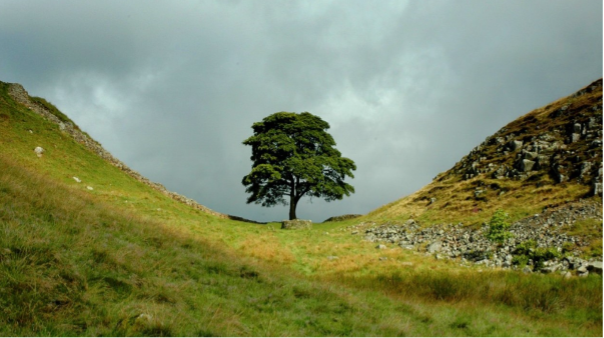
A beloved section of the Wall is known as Sycamore Gap, which once housed an ancient Sycamore tree. Sadly, the tree was hacked down a few years ago, and I’m not kidding when I say, “a nation mourned”. The scene of the lone tree in a dip in the earth was iconic – I even have a pair of filigree-type silver earrings of the tree, which I bought at The Sill. If you’re in the area, The Sill is a fantastic visitors’ centre with everything from exhibitions and learning opportunities, to local craft beer, textiles, and art.
There are Roman sites on both sides of the River Tyne; you can take your pick from whole villages like Corbridge, forts along the wall such as Housesteads and Vindolanda, the baths at Chesters, and the Mithras Temple at Carrawburgh. In the centre of Newcastle, the largest city in the northeast, there are many parts of The Wall still standing, and shoppers often walk straight past without a backward glance. As in much of England, when developers start digging foundations for a new building, there’s always an unspoken dread that they’ll come upon yet more ancient artefacts and the project will grind to a halt.
Apart from Heddon-on-the-Wall and Denton Hall, mentioned above, urban and suburban discoveries are still being made. As recently as 2017, developers discovered the remains of a substantial civilian settlement in Benwell, west Newcastle. It had been buried under early-twentieth-century housing, which was being demolished to make way for new construction.
Roman artefacts also pop up all over the place. Recently, Bremenium Fort in High Rochester has unearthed a huge cache. Volunteers and archaeology students have found artefacts ranging from soldiers' arrow tips to decorative brooches, oil lamps, pottery, and metalwork. In 2017, a pair of leather boxing gloves was discovered at Vindolanda, and experts have concluded that they were sporting wear rather than combat gear. All give remarkable insights into the living conditions and trading practices of the time.
Last year also saw a fascinating discovery of HUGE shoes. We typically think of people who lived two thousand years ago as being smaller in stature than current homo saps. Possibly not so for the wearers of thirty-two shoes found at the Magna Roman Fort. They equate to sizes 13 or 14 in today’s men’s shoe sizes, and experts currently have little clue about the wearers. It’s not clear whether there were people around at the time with massive feet, or whether the shoes were made large enough for several layers of foot-warming fabric. I’m tempted to wager the second, given the climate of Northumberland.
So yes, when we say there’s history all around us in regular British life, we really mean it. And it’s still being unearthed!
1 like
Post a reply