Sunday Post: Sunday Post: Hadrian’s Wall Planning Update - Plus The Vindolanda Tablets
This week, I give an update on my plans to walk Hadrian’s Wall in August, plus we explore the amazing discovery that gave us a personal window into life on Hadrian’s Wall - the Vindolanda tablets.
Member Update
We’ve had a bit of member churn this month, but we’re holding now at 259 members, which is fantastic. There’s a lot of work ahead, but I’m hoping we can increase our numbers to 300 by the end of the first quarter of this year!
The Podcast may be on hiatus, but we’re working hard on ramping up for its return. Interviews start next week, and we have a fascinating line-up of people to come! We can’t wait to share it all with you!
Highlights from the forum this week:
- New Film - Downton Abbey Spoof - Fackham Hall
- Boxing Day Traditions
- Bookish - New Post-WII Crime Drama
- First Look at Young Sherlock Holmes - New Guy Ritchie Series
- Britain in 2026? Who’s Going?
Sunday Post: Hadrian’s Wall Planning Update - The Vindolanda Tablets
Reality hit hard once New Year’s was done. This walk is happening in 8 months!
As usually happens during the holiday season, not much exercise took place, and there was a lot of unhealthy eating, plus lots of slothfulness (I use the Christmas break to rewatch both Lord of the Rings Trilogies). So, I did not walk much in December. So, the last couple of weeks have been about setting new habits (again) and getting moving.
The walk is happening. It’s scheduled. I have to do it. I have to get my body in shape, and this is proving to be the hardest part of all. I’m following a training regimen that will slowly build up my ability to walk long distances. During the workweek, I need to walk at least 2 miles a day. It’s most important to MOVE. I’m usually doing these walks in the mornings before work. It’s lovely doing it with my new walking companion, Hudson, the most handsome puppy that ever lived.
Then, on the weekends, the real work begins. I have to walk longer distances. For example, yesterday, I needed to walk seven miles. There was a lot of buildup to this walk. I was really unsure as to whether or not I could actually do it, or if the weather would cooperate. It turns out, it doesn’t matter if the weather is cooperating; I have to walk. I’m not going to have a choice about the weather in August! 7 miles doesn’t seem that far, but it’s definitely the longest walk I’ve ever taken on purpose.
The problem with long-distance walking around Northwest Indiana (where I live) is that there are not many long-distance walking trails, despite there being loads of state and national parks. So, for yesterday’s walk, I resolved to just do my favorite ‘long’ walk twice. The Bailly and Chellberg Fram Trails ‘loop’ takes 3.5 miles or so.
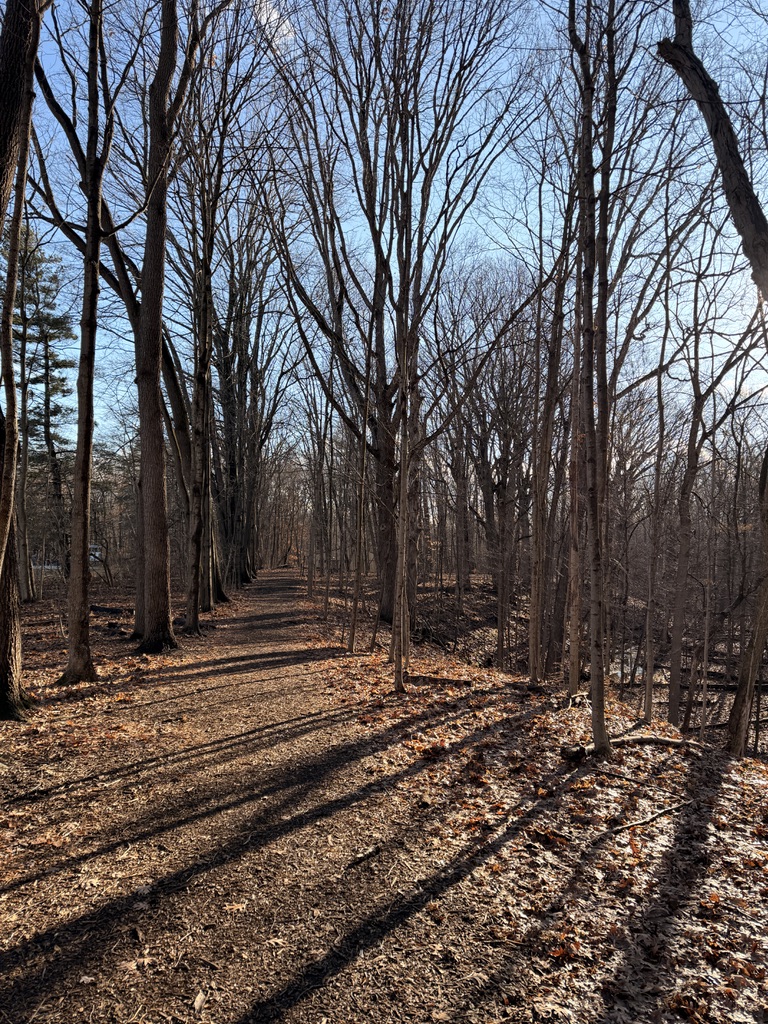
I arrived around lunchtime, and it was snowing and freezing cold. But I was prepared in snow boots, flannel-lined pants, a thermal coat, a hat, and gloves. I was toasty warm. Thankfully, the snow stopped, and the weather was fine the whole walk. I did the loop the first time, and that was easy enough; by the end, I was sore and tired as usual. I was also so warm, I’d shed the hat and gloves and opened up my coat. But instead of finishing, I stopped and had a quick lunch. Stopping was…. I needed to do it, but stopping made things hurt immediately. I also got cold immediately. So, I ate, used the bathroom, bundled up, and began the second loop.
I should add that I also got to test a new bit of kit that I got for Christmas. I got a hiking backpack from my parents for Christmas that includes a water bladder and a straw that I can drink from as I’m walking. It was a bit of a faff getting it set up, but once it was working, it was quite nice to have cool water on demand. It wasn’t too heavy on my back, and the backpack also had a handy spot for my phone to make it easily accessible while walking. My only complaint is that the water tasted like the container it was in, but I’m sure after a few uses, that will go away. Here is the backpack if you’re curious.
I will easily admit that this was a very difficult walk. Even with the company of my audiobooks and podcasts, it was hard going. Again, the weather stayed nice, and the sun came out. But by the halfway point of the second loop, every part of my body hurt. My pace was slow and getting slower. But with the way the paths are laid out, you have no choice but to continue the route. I had to finish. The last half mile is very challenging as there are loads of stairs and bridges. By the time I made it to my car, I could barely move anymore.
But I did it! I walked 7.2 miles! Everything hurt, but I managed to go on my longest walk ever. I burned something like 1600 calories. It was a bit of a wake-up call, though. I have to repeat this every weekend for the next 8 months, increasing my distance every weekend. There’s a lot of work ahead. But, in theory, it will get easier the better shape I get into. The longest stretch of walking on the Hadrian’s Wall National Trail is 16 miles in a day. Yesterday was only about half of that. I know I can do this, it’s just going to take so much discipline.
As for planning. I’ve done more planning! Because that’s the fun part, right? Two major decisions/actions were taken in the last week.
First, I booked my plane ticket for August! So, I’m actually going! British Airways has a sale on right now, so I’m quite pleased that I got my ticket for about $600, which is not bad for August!
Second, I added a day before I start the walk. Some explanation needed. I have a set date when I need to arrive in Newcastle. I arrive, sleep overnight, then start the walk the next day, which is a 16-mile stretch from central Newcastle into the countryside. But reading the guidance from Macs Adventure and from my various guidebooks, they all suggest actually starting the walk the day you arrive in Newcastle. They recommend visiting the Wallsend museum, getting your Hadrian’s Wall passport stamp, and then walking the first 5 miles since it’s a bit of an easy amble in the middle of a city along the river. Then, you only need to return to the spot you stopped the next day and walk the remaining 11 miles to finish the ‘first leg.’
I have decided to take that advice. But I don’t want to do this literally the day I arrive in Britain. Getting off a transatlantic flight, taking a 3-hour train to Newcastle, and then walking five miles, seems…. optimistic. So, after conferring with Mrs. Anglotopia, I’ve decided to leave the USA a day earlier (oh darn). I’ll still take the train north when I arrive, but I’ll stop somewhere else before arriving in Newcastle the next day. That gives me some time to get over jetlag and get my bearings. Still arranging accommodation, but there’s a castle hotel near Newcastle I have my eye on. I’d like to visit the Beamish Living Museum as well before I get to Newcastle, somewhere I’ve always wanted to go.
Then, when I do get to Newcastle, I’ll be rested, and once I check in to my hotel, I can then ride the Metro to Wallsend, get my Hadrian’s Wall passport stamped, and walk the first five miles, which will put me near my actual hotel for the night.
It’s all coming together! Now, I just need to go for a short walk today to show that I can get up and go for a walk the day after a long-distance walk. It’s all building towards something!
The Wall Into the Modern Era
When the 20th century dawned, Hadrian's Wall existed in a curious limbo. Thanks to John Clayton and the Victorian antiquarians, the central sections had been saved from complete destruction, but the wall remained largely the province of a few dedicated scholars and adventurous tourists willing to navigate rough countryside. Over the following twelve decades, everything would change. The wall would yield some of the most significant archaeological discoveries ever made in Britain, attract millions of visitors, become a UNESCO World Heritage Site, and inspire one of the country's most beloved long-distance walking trails.
This is the story of how a crumbling Roman frontier became a living monument to our shared past.
The Birley Dynasty: A Family Obsession
The modern understanding of Hadrian's Wall owes an enormous debt to one family. The Birleys—spanning three generations—have done more than anyone to excavate, interpret, and popularize the wall's history.
Eric Birley (1906-1995) established himself as the foremost authority on Hadrian's Wall during the mid-20th century. A professor at Durham University, he purchased the Vindolanda site in 1929 and began systematic excavations that would continue for decades. His scholarship established the framework through which we understand the wall's military organization, its garrison units, and its place within the broader Roman frontier system.
But it was Eric's son Robin Birley who would make the discovery that transformed our understanding of Roman Britain. In the spring of 1973, while excavating the deep, waterlogged levels at Vindolanda, Robin uncovered what appeared to be thin wood shavings. Upon closer examination, they revealed traces of writing in ink. These fragments—the Vindolanda Tablets—would prove to be the oldest surviving handwritten documents in Britain.
The discovery was utterly unexpected. Organic materials like wood and ink rarely survive for nearly two thousand years. Yet Vindolanda's anaerobic conditions, created by successive layers of clay deposited during the fort's repeated rebuilding, had preserved not just the tablets but a treasure trove of leather shoes, wooden objects, textiles, and other everyday items that would normally decay within decades.
Today, Andrew Birley—Robin's son—continues the family tradition as director of excavations at Vindolanda. The site remains one of the most active archaeological digs in Europe, with volunteers from around the world participating in excavations that consistently yield remarkable discoveries.
The Vindolanda Tablets: Voices from the Frontier
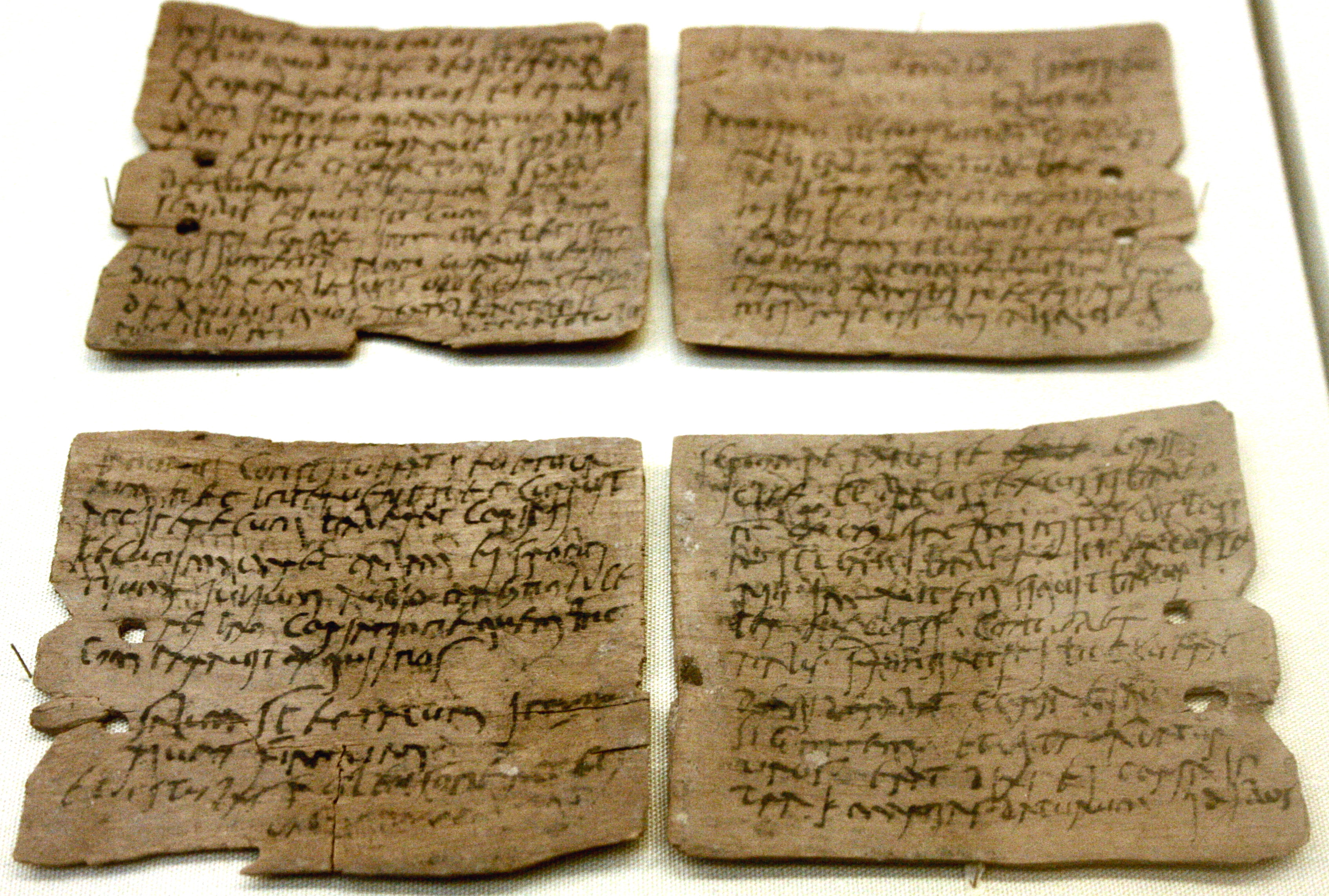
The Vindolanda Tablets rank among the most important archaeological discoveries of the 20th century. More than 2,000 tablets have now been found, most dating to the period between AD 85 and 130—slightly before Hadrian's Wall was built. They offer an unprecedented window into daily life on Rome's northern frontier.
Unlike the grand inscriptions and official documents that typically survive from the ancient world, these thin wooden postcards contain the everyday correspondence of soldiers, their families, merchants, and administrators. They reveal a vibrant, surprisingly familiar world.
One famous tablet contains what may be the earliest known example of a woman's handwriting from Britain—an invitation from Claudia Severa to Sulpicia Lepidina, wife of the fort commander, asking her to attend a birthday party. Another records a soldier requesting that his family send more socks, sandals, and underwear—a timeless complaint about military supply chains. A merchant named Octavius writes anxiously about a grain deal gone wrong, worrying about losing his deposit.
Military documents reveal the mundane realities of garrison life: strength reports showing how many soldiers were sick, wounded, or suffering from eye infections; requests for leave; inventories of supplies. One tablet describes the local Britons dismissively as "Brittunculi"—"wretched little Britons"—who don't use cavalry and whose "cavalry" don't use swords. The cultural condescension of empire echoes across two millennia.
The tablets were written in ink on thin slivers of wood, usually birch or alder, typically in pairs that folded together like postcards. When found, they are incredibly fragile—early examples deteriorated rapidly when exposed to air. Modern conservation techniques, including infrared photography to enhance faded ink, have allowed scholars to read texts that would otherwise be invisible to the naked eye.
The tablets are now held at the British Museum, where they featured in the 2003 BBC documentary "Our Top Ten Treasures" and were voted the public's favorite British archaeological find. A selection is also displayed at the Vindolanda Museum on loan from the British Museum.
Post a reply