In celebration of finishing my latest memoir about Britain (I finished the last chapter Friday!) - Searching for the Heart of Britain - I'm sharing another excerpt - and one of the 'new' original chapters created for the book. This is something I haven't written about before and just needed the opportunity, which the book presented. A few years ago, the RAF Red Arrows came to my local town in Indiana, and I got to meet them.
Member Update
We're holding at 250 members. In case you missed the news last week, the Video Site is now available for everyone. Simply download the free Anglotopia app and tap the 'video' icon at the bottom of your screen and you can enjoy about 30 lovely videos about Britain, we're adding more every day - videos from our archive but also new videos. Eventually, all our new stuff will go there first. So check it out!
I love the smell of jet fuel in the morning. I’m standing on the tarmac of a major airport, well beyond security, just outside a hangar in a hastily arranged press area. It was quite something to be on the tarmac of a working airport, well beyond where the public is normally allowed. It was early morning, and I was standing with the Chicago press, awaiting the arrival of something that had never happened in Chicago before. The Red Arrows were coming to Chicago, and I’d somehow managed to be there for their arrival.
I knew when it was announced that the Royal Air Force Red Arrows would be coming to Chicago, that I would have to be there, somehow, some way. It’s rare that I get a chance to cover something for Anglotopia on my local patch in Northwest Indiana, Chicago. There’s not much ‘British’ going on here other than a vibrant business chamber and a few wonderful pubs.
When the Red Arrows came to Chicago in 2018, it was the first time in 11 years the Red Arrows had been in North America, and the first time in Chicago. Not only would they perform at the iconic Chicago Air and Water show, but they would also be based practically down the street from me at the Gary Airport, a major airport just 30 minutes from Downtown Chicago. Not only that, it would be their first stop on their North American tour, which meant that they would quite literally leave the UK (Scotland to be exact) and basically hop air bases across Canada and North America until they would touch down at humble Gary Airport.
A few weeks before their arrival, I flexed a muscle I rarely have to flex as the publisher of a publication based in the USA, but almost completely about another country. I asked for press access to their visit. I explained to the Chicago Events management people that I was an American-based publication dedicated to all things British, and could I please have access to the Red Arrows? I was very, very surprised when an email came right back and said yes, absolutely. I was invited to everything!
So, there I was, standing on the tarmac with all of Chicago’s press corps - names, faces, and voices, I recognized from TV and radio, just me in my Anglotopia Polo and my cameras. I was woefully unprepared; I didn’t even have the right lens to be covering aviation! But it was strange to be considered a peer with the Chicago press. Talk about imposter syndrome. But there was no room to be an imposter, I was treated by the kind RAF officer press liaison like just another member of the press. He didn’t need to know I worked out of a home office and rarely interacted with the public except through social media.
As an American who may not have heard of them before, the Red Arrows are the Royal Air Force’s equivalent to the US Navy Blue Angels or the Air Force Thunderbirds. They are Britain’s elite corps of skilled pilots who travel around the world performing their aerial acrobatic skills in fighter jets, showcasing the “Best of British” wherever they go - that is, highly trained pilots who you can count on in a scrap. They are the descendants to the brave pilots who flew Spitfires and Hurricanes during World War II and saved Britain in its hour of need.
The Red Arrows didn't just appear in Britain's skies—they were forged from necessity, ambition, and the RAF's determination to create the world's most spectacular aerobatic display team. Born in 1965 at RAF Fairford, the team emerged from a consolidation of various RAF aerobatic units into a single, elite formation that would represent British aviation excellence on the global stage.
Before the Red Arrows, the RAF had flown multiple display teams throughout the 1950s and early 1960s, including the famous Black Arrows, who set a world record in 1958 by looping 22 Hawker Hunters in formation at Farnborough. But maintaining several teams proved expensive and logistically complex. The solution was radical: create one supreme team flying red-painted training aircraft rather than frontline fighters, reducing costs while maximizing impact.
The name itself came from the team's distinctive red Folland Gnat aircraft and their signature arrow-shaped formations. That first season in 1965, flying from RAF Kemble under Squadron Leader Lee Jones, the team performed 65 displays across Europe. The choice of the Gnat—a nimble jet trainer rather than a heavyweight fighter—proved inspired. Its agility allowed tighter formations and more dramatic maneuvers than larger aircraft could achieve.
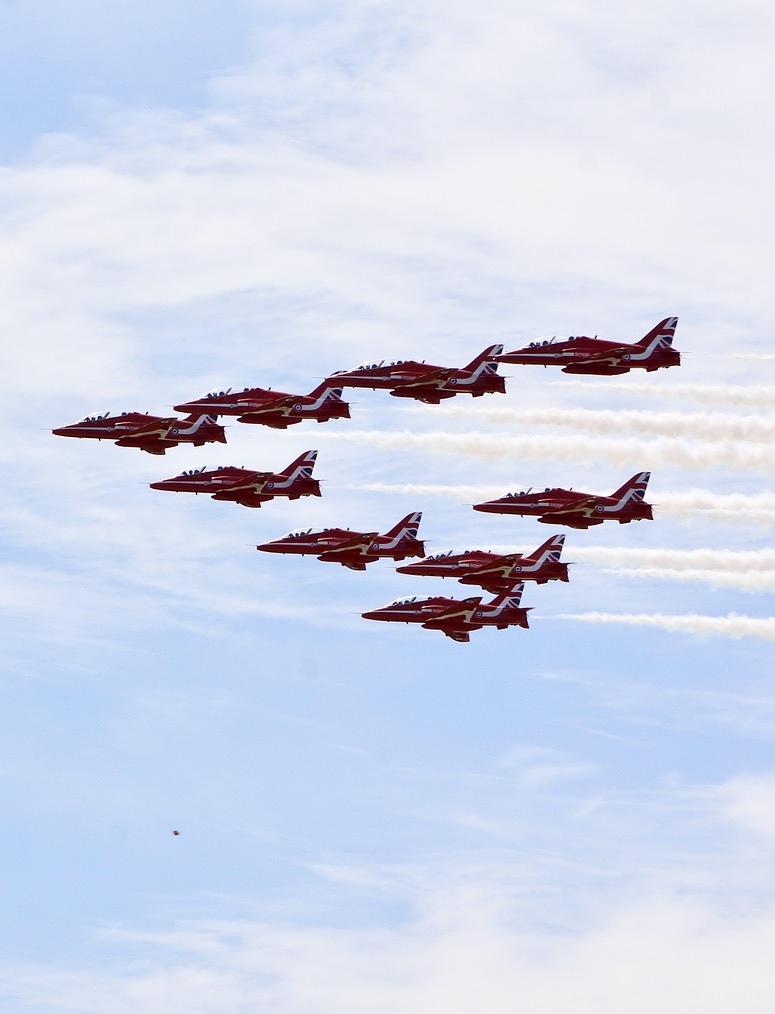
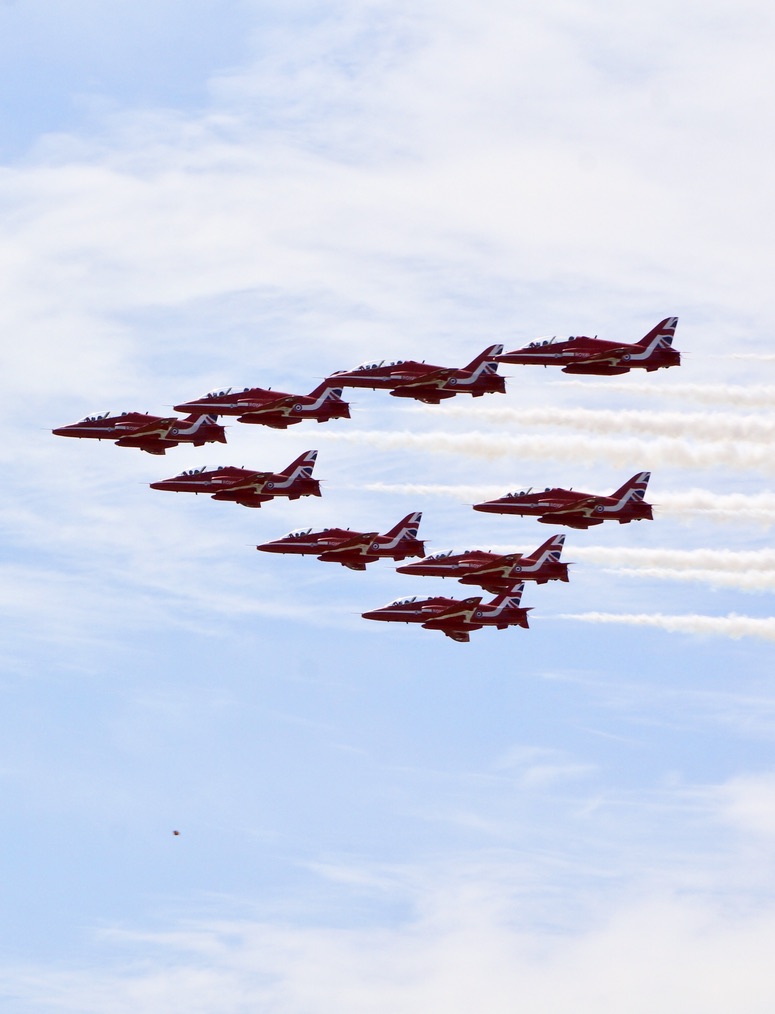
In 1980, the team transitioned to the BAE Hawk, the aircraft they still fly today. The Hawk's greater power and reliability enabled even more complex displays, while its distinctive red, white, and blue livery became instantly recognizable worldwide. The team's signature "Diamond Nine" formation—nine aircraft flying wingtip-to-wingtip—became their calling card, requiring precision measured in feet at speeds exceeding 400mph.
Beyond the spectacle, the Red Arrows serve as Britain's aerial ambassadors, performing at state occasions, royal celebrations, and international airshows. They've flown over Buckingham Palace for royal weddings and jubilees, led funeral processions for national heroes, and represented British engineering prowess from Beijing to Brasília. Their displays require extraordinary skill—pilots train for three years before even joining the team, and must have flown at least 1,500 hours on fast jets (that’s fighter jets for those who don’t know the lingo).
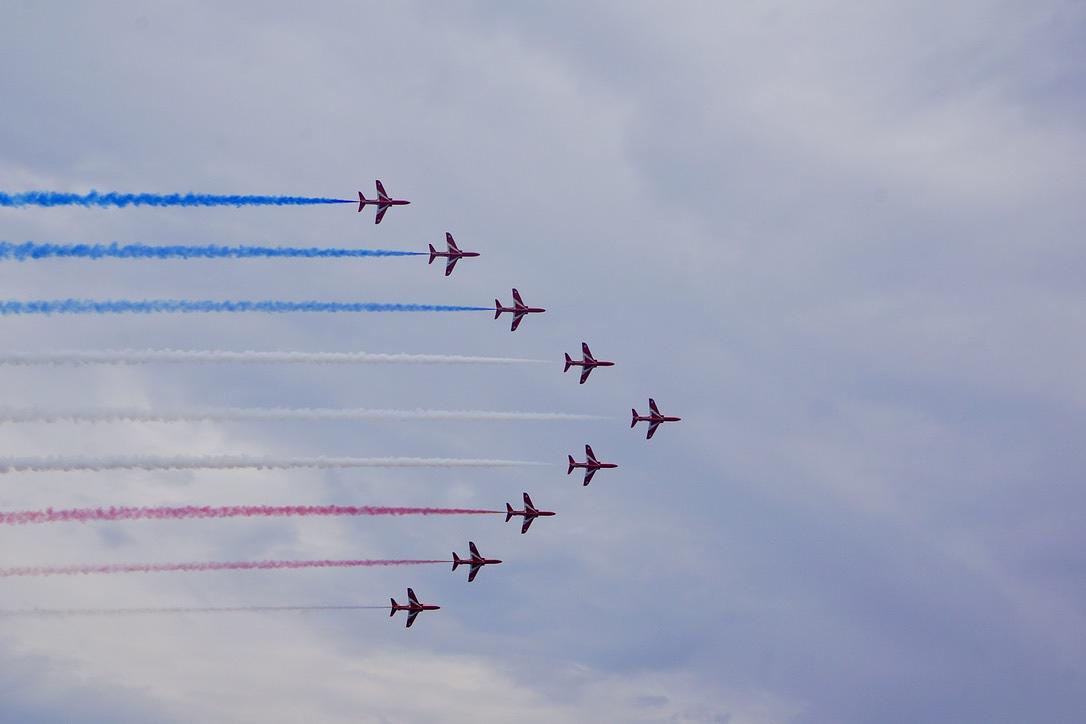
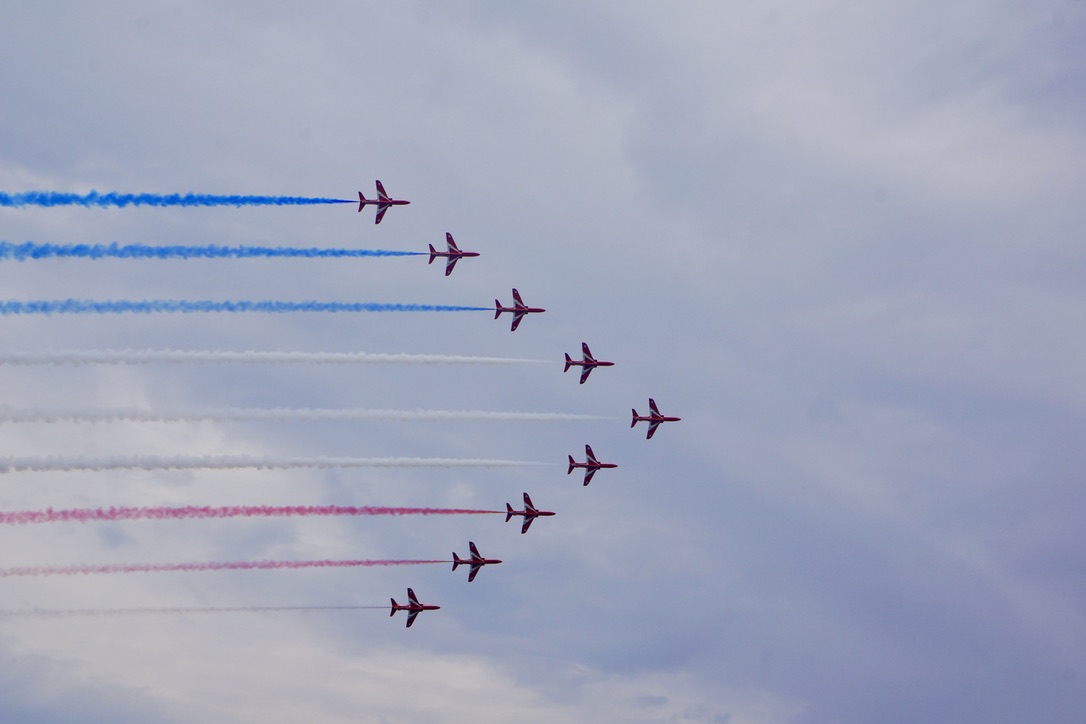
The team's famous red, white, and blue smoke trails, produced by pumping diesel fuel into the jet exhaust, have painted the skies for six decades. Each display tells a story of British precision, daring, and showmanship—a 20-minute performance requiring months of practice and split-second timing. In an age of remote-controlled drones and computer-assisted flight, the Red Arrows remain defiantly human, nine pilots flying within meters of each other, trusting their training, their aircraft, and each other.
While we awaited the arrival of the Red Arrows at Gary Airport, the RAF press officer (see if you can find his name) opened up to questions. Someone asked about the route they took from the UK.
“They went from RAF Scampton in Scotland to Iceland, Iceland, to Greenland, Greenland to Goose Bay, and then Goose Bay to Halifax, Halifax, to afterward and now becoming here.”
When flying across the Atlantic, I asked if they practiced at all or just cruised. He said they flew in formation, but they did not practice any aerobatics. The focus was on crossing as quickly as possible. A single-engine plane is dangerous (across the Atlantic), pilots were in full immersion suits in case they went down. They did not fly transsonic, they flew at about a .6 Mach cruising speed.
But the arrival of the jets was only the last part of a delicate ballet that began weeks ago. The Red Arrows would be in North America for 11 weeks, which meant that they would have to bring everything they would possibly need with them (including a spare jet in case one broke down). 110 personnel, not including the pilots, were needed to keep the show going in North America. That includes the engineers who service the aircraft between displays, police, drivers, medics, and anyone they would need in an emergency. The RAF is prepared for anything. That also includes engines, bolts, special fuel mixtures for the exhaust displays, and even an eleven-week supply of Yorkshire Tea (stowed safely in one of the small shipping containers they brought with them.
“Yes, the preferred tea of the RAF is Yorkshire Tea,” said the press officer. I chuckled; the rest of the Chicago press would not understand that this was hilarious. But also understand, Yorkshire tea is one of the best British teas (I happen to drink it every morning, and in fact, and drinking it while I write this chapter).
The RAF has a long association with Yorkshire, so it makes sense that it would be their preferred tea. Yorkshire's relationship with the Royal Air Force runs deeper than almost any other English county, forged through war, geography, and an enduring military tradition. During World War II, the county became the operational heartland of RAF Bomber Command, its flat eastern landscapes and strategic position making it Britain's primary launching pad for operations against Nazi-occupied Europe. Dozens of airfields sprouted across the Vale of York and the Wolds—Driffield, Elvington, Pocklington, Linton-on-Ouse, Leeming—where 55,573 Bomber Command aircrew, many operating from Yorkshire bases, would ultimately sacrifice their lives. These bases housed international crews from across the Commonwealth who lived in Yorkshire villages, creating profound bonds between local communities and the men who flew dangerous night missions before disappearing into European skies.
The county wasn't merely passive terrain but an active participant in aviation's development. Sheffield's steel industry provided crucial materials for aircraft construction, while engineering firms supported the war effort with precision manufacturing. Post-war, RAF Linton-on-Ouse became a primary flying training base where generations of pilots took their first solo flights, while RAF Leeming continues operating fast jets today. Yorkshire's industrial heritage dovetailed naturally with aviation's demands, creating aerospace supply chains and support industries that continue serving the RAF and broader sector into the 21st century.
This deep connection permeates Yorkshire culture in ways both obvious and subtle—pub names honoring bomber squadrons, churchyards with Commonwealth war graves, and the Yorkshire Air Museum at Elvington preserving this heritage on a former bomber base. Annual remembrance ceremonies at former airfield sites draw crowds honoring those who flew from Yorkshire soil, while the distinctive layout of wartime bases remains visible across the landscape in repurposed runways and converted control towers. The roar of Merlin engines may have faded, but Yorkshire's RAF legacy remains embedded in the county's identity, a story of community, sacrifice, and the enduring bond between the white rose county and the service that once filled its skies with the sound of freedom's defense.
“They’re not far now,” said the press officer, hearing squaking on his radio.
He then went on to explain how they communicate during air displays to fly in formation. I’m not going to pretend to try to explain it. I’ll put what he said, and you can try to figure it out!
“Yeah, so as the pilot turns one to nine, because it's always nine that the display red one, everybody runs off, right. One is a leader. And they run off his voice not side because if they do it by side, they'll be app. So everything is done on the cadence of the voice. And if you down at the air show over on Sunday, Sunday, we have a pilot rate 10 and he is there to safety and commentary. So he will be commentating as they do now, it also has ratings right once you hear red One’s audio, and you'll hear how they use a cadence to do all of the different views.”
Sure, perfectly straightforward.
And then, suddenly, they were there. There was a piercing thunder as they appeared right above us, all in formation. They gave the awaiting press a small flypast, even showing their signature white smoke out of their tails. It was thrilling. What a moment. I’d seen the Red Arrows once before, during the Queen’s Diamond Jubilee, when they flew over London. This was so much closer. We could practically touch them.
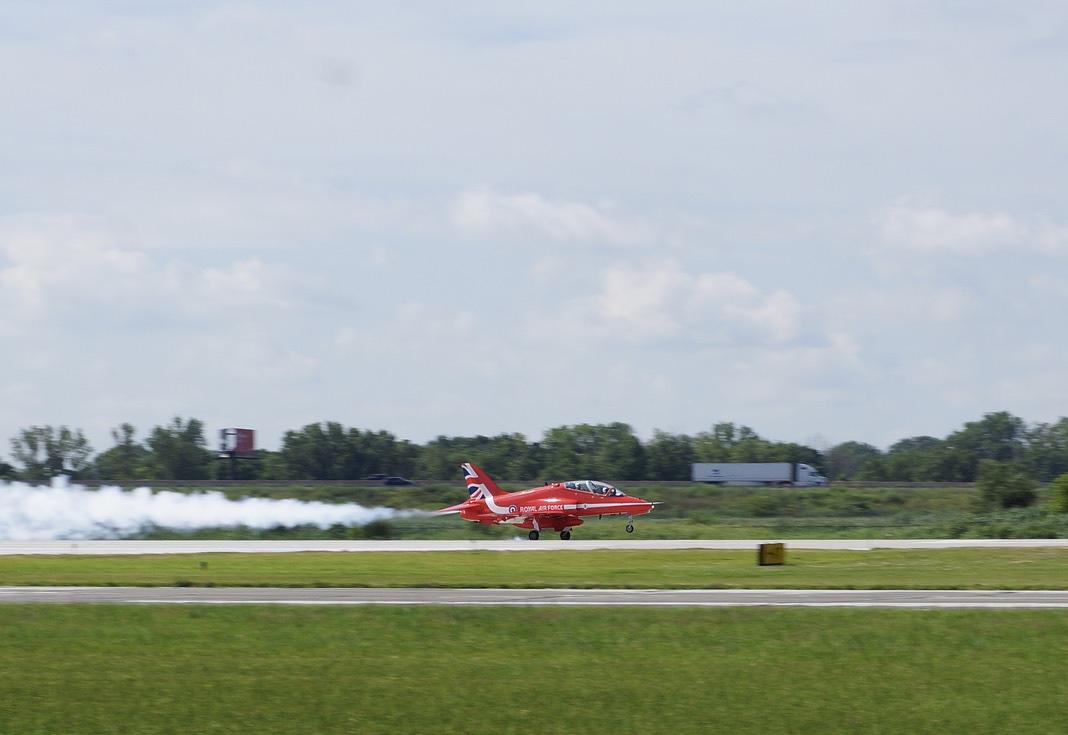
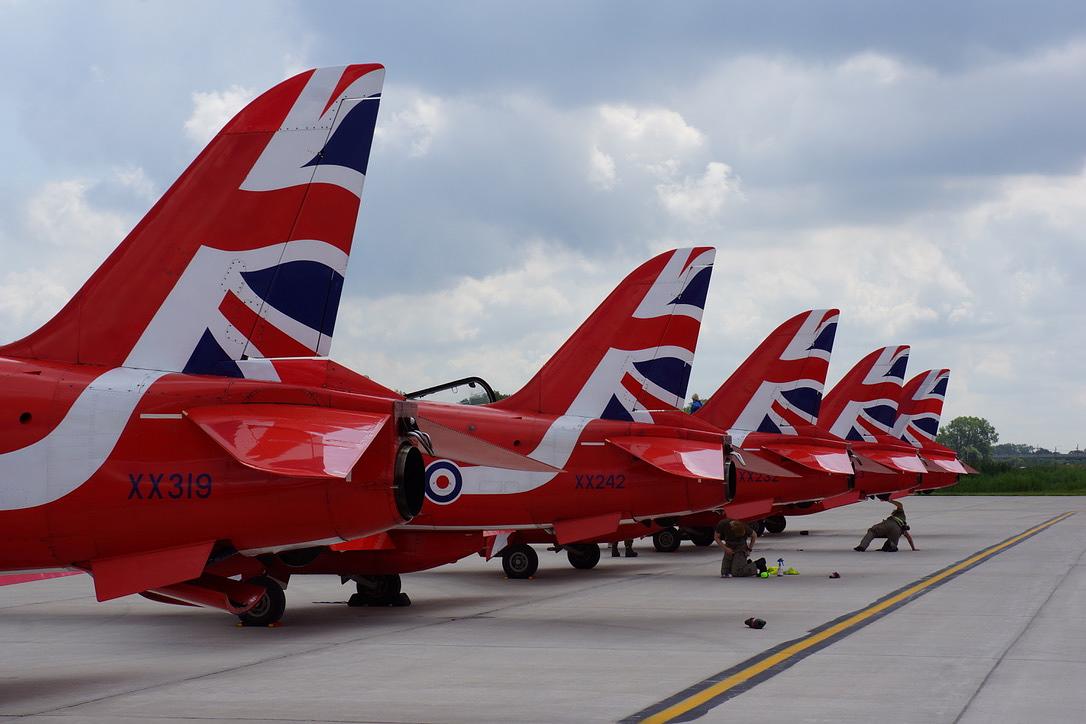
After their flypast, they turned around and began landing one by one, taxiing into their parking spaces on the apron right in front of us. We were so incredibly close. They’d started the morning in Halifax, Canada, and now they were here in Indiana. They had never flown there before, but the ballet of them landing, taxiing, and parking on the stand was performed with complete precision. We couldn’t talk to the pilots yet, they needed, uhm, refreshment after flying for several hours. I hope they found the facilities at the Gary Airport up to scratch.
The crew on the ground then gave us a tour of the airplanes, and we got to walk right up to them. Most people, not even British people, can ever get this close to a Red Arrow! What struck me most of all was just how RED the aircraft actually were. The red color was almost blinding. And it made the heart warm to see the Union Jack on the tails. A small press conference followed. There were remarks by the then Consul-General of Chicago. Then ‘Red One’ made a little speech. It was all perfunctory and nice, and unfortunately, I was a bad reporter and didn’t write anything down or remember to turn on my recording equipment.
I guess I was just too excited to see the Red Arrows! This was a British invasion I could get behind.
I went home that day in a complete daze! It was a few days yet until they would be performing at the Chicago Air and Water Show. As soon as I got home, I immediately ordered a new camera long lens because I knew that if I had any hope of photographing the Red Arrows during the air show properly, I was going to need it. I spent the next few days training with the lens so that I knew how to use it quickly, because I knew one thing for sure: the Red Arrows would not be waiting around for me to get my camera situated!
When the big day arrived, I followed the instructions provided by the Chicago Events management people, and parked at Millennium Park, then waited for a special bus that brought me to North Avenue Beach, which was the center of activity for the air show (and where the ‘box’ of the airspace for performances was set. I was ushered to the press area, and that was a bit surreal. There was a section of beach where we could stand with our cameras completely away from the crowds. It was quite a privilege to have a front row seat and not have to deal with the crowds like a regular punter. There was also an area under the stands where we could shade from the sun. I learned that’s where most of the ‘old-timers’ used to this sort of thing pretty much camped out all day, only lifting their long lenses when it required them to. Very few actually left the shade to shoot the air show!
The weather wasn’t great for the Red Arrows. It had rained a bit, and the skies were cloudy. If anything was going to be canceled, it wouldn’t be until the last minute. I had a pass for the whole weekend, so it didn’t matter if they called off the show for today. But the British aren’t about to let a little bit of rain ruin their air show performance!
It was quite a scene of Anglo-American relations - the US Army always does parachute landings at things like this, and one of their soldiers sailed into the landing zone with a Union Jack flying behind him. A nice honor!
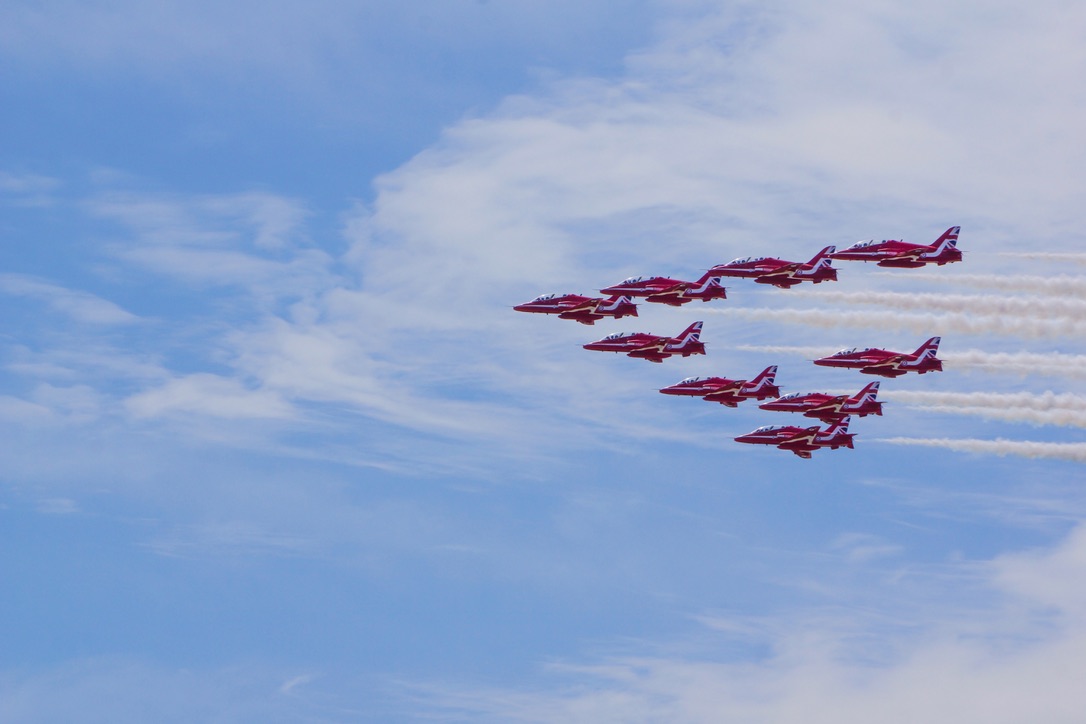
And then suddenly, they were there. With narration provided by another Red Arrow pilot, the Red Arrows flew through the box of the performance area at full speed and then began their acrobatic performance. They split into teams and flew at each other, doing formations and loops and flying in and out of the Chicago Skyline. It was, quite frankly, one of the most incredible things I’d ever seen.
They were definitely the most crowd-pleasing - the only ones where people were standing and clapping. They had the best display by far, and I didn’t want it to end. They flew with such skill and precision. At one point, you thought the planes were going to fly right into each other. Some flew upside down. Sideways. Over and under. IT WAS SO FAST.
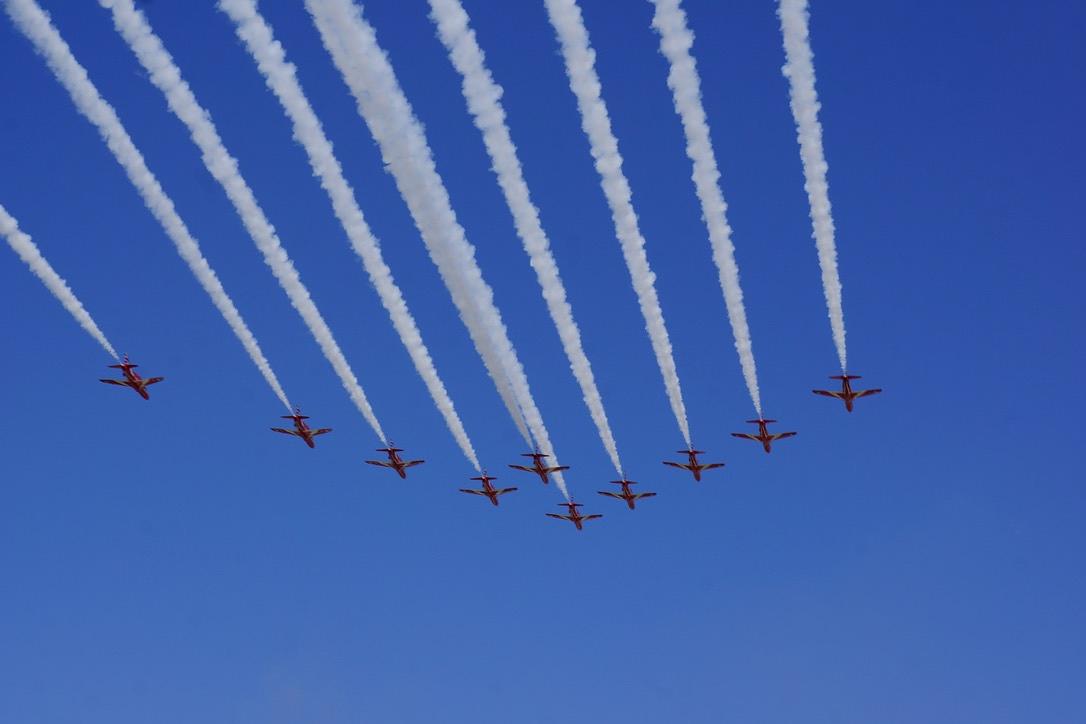
They ended their display flying proudly in formation, with their signature red, white, and blue smoke out of their tails. I could hear Churchill and “Land of Hope and Glory” playing in my head as they flew by on their final pass.
And then it was over! I very much didn’t want it to be over. I’m a bit of an AVGeek, so I wasn’t going to leave the press area until I’d seen the whole airshow. We didn’t have the weather on our side. At one point, operations were paused while some rain passed through. I was very, very happy to be at a major airshow with a proper telephoto lens. Not to be outshone on their own turf, the Air Force did a major display of fighter jets, A-10s, and mobile refueling aircraft.
Then, of course, the show ended with the US Navy Blue Angels. Who was better?
As a proud American and someone who also loves Britain, can’t I just say they both did great?
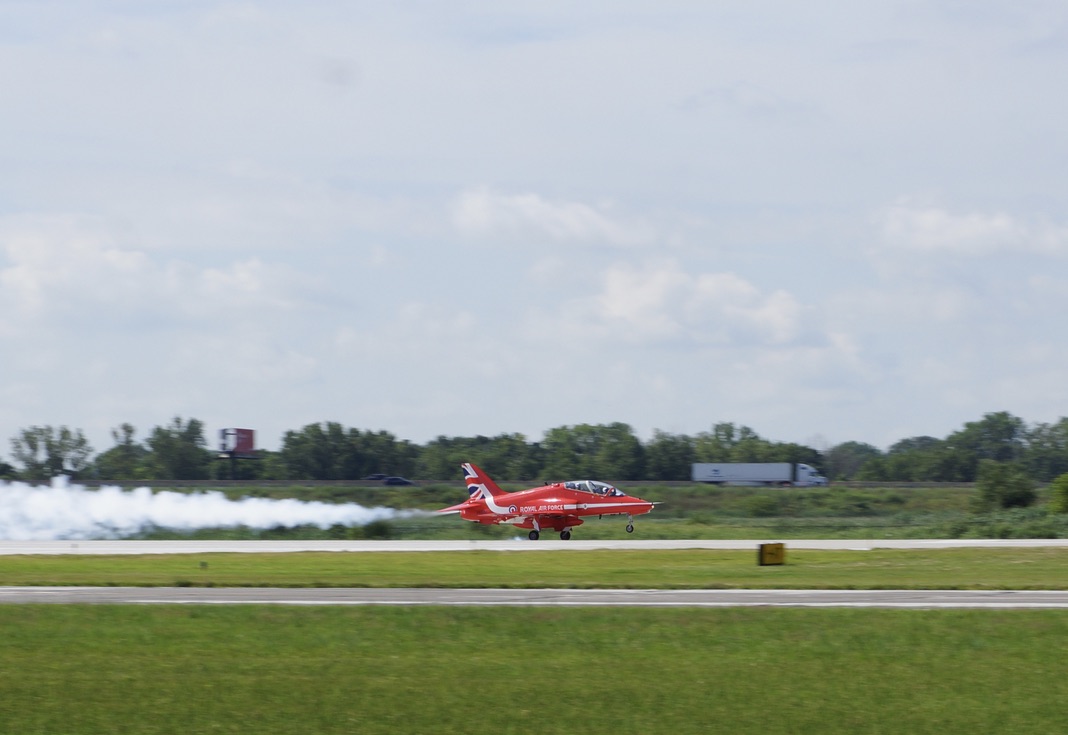
The next day, I pondered going back to the airshow just to watch them again, but that seemed absurd. But then I realized, I should have, so I did the next best thing. I hopped in the car with my wife, and we drove over to Gary Airport and parked in the throngs of other AVGeeks who were watching the plane movments at Gary Airport (protip if you don’t want to actually go to the Chicago Air and Water show, you can watch the planes take off and land in Gary, which is practically an air show itself). I knew what time they were performing, so we’d managed to time it perfectly to their return to the Airport, at which point they did a flypast, blowing their smoke and performing a mini-air show for the people gathered there.
The irony is that I was much closer to them than during the actual Air and Water Show, and that’s when I got my best picture of them, where you could see all of them in formation and practically see the pilots in the cockpits. It’s the picture that is framed and on my wall to this day. After their mini airshow, they landed and were done performing for Chicago. A few days later, they left for their next air show stop. The Red Arrows have since been back to North America - they did a tour of Canada a couple of years ago - but they haven’t been back to the USA, and probably won’t for some time.
I will never forget my few summer days chasing the Red Arrows. It was a rare chance for the Heart of Britain to come to me, and they were the Best of British indeed.
2 likes
Post a reply