This week, I share another excerpt from my upcoming book 'Searching for the Heart of Britain' - this original chapter is about our favorite hotel in London, which we've gone off of a little bit, but still have a soft spot for. Will we stay there again? I don't know. You'll understand more when you read it! Again, as with the last excerpt, this is still a work in progress and hasn't gone through 'refinement editing.'
Member Update
We're holding at 250 members. Hopefully, once all the monthly renewals go through next week, we'll stay there! I'm putting the finishing touches on the new video site this week. I'll send out a special newsletter/email when it's ready.
One of my favorite scenes in the Harry Potter films is when Harry visits Sirius Black’s house for the first time, and through magic, a lovely terraced house in London, shabby and having seen better days, magically appears on a smart street in London. Once they go inside the house is positively topsy-turvy and full of the kind of old-world character you would expect of an aristocratic family like the Black’s. What if I told you there was a hotel in London that was a bit like that, and you could actually stay there?
Choosing a hotel in London is a very personal decision. There are a lot of factors that play into choosing it. For most Americans traveling to Britain for the first time, the biggest factor is cost. Second would probably be location. Character or being an interesting place is far down the list. Character, if you’re not careful, can mean the rooms will be small and you’ll barely be able to move around the room and around your luggage or be using a shared bathroom down the hall. Most people, once they find a hotel, will return to that hotel on visit after visit, even if it’s just all right. My fellow Americans are creatures of habit.
That is not a criticism, because I’m a creature of habit. I’ve stayed at the same hotel in London on every visit for the last 10 years. I found out about Hazlitt’s from Anthony Bourdain, not personally, mind you, but from his TV show, No Reservations, back in the halcyon days of interesting travel channel TV shows. Bourdain described the hotel thusly: "It is like staying at a potty English uncle's when he is not at home.” When he walked around the hotel on the show, it looked like it was full of character, and it had a key feature that appeals to my most writerly pretensions: the hotel was popular with writers. Sold. He returned to the hotel several times through the course of his shows, and in the mid-2010s, we finally had the chance to stay there, and it made such an impression on us that we haven’t stayed anywhere else since, but unfortunately, we may not stay there again, because time, like London, always marches on.
Hazlitt’s is, quite literally, in the heart of Soho in London. Soho, for those unfamiliar, has had a long association with the West End, filled with theaters, bars, private clubs, and restaurants; it’s where London goes to have a fun night out. Soho has a checkered history. For most of the back half of the 20th century, it was London’s red light district, home to strip clubs, prostitutes plying their trade (as ‘models’ up scary-looking staircases up open doors on the street). If you wanted to get into trouble, you went to Soho to do it (and I’m not including the drugs). Soho, let’s just say, has had a seedy reputation longer than it hasn’t had one (if you want a good film to watch to get a feeling for this time, watch “Last Night in Soho”).
But in the early 2000s, it started to get cleaned up. Many of the strip clubs and peep shows were closed down. The bars and restaurants went through a renaissance, and the former prostitute flats got bought up by property developers and turned into real flats for regular people. Movie studios put their London bases in Soho Square, and the Elizabeth Line brought new transport links and shiny new stations. Soho changed its look and feel. Until we stayed at Hazlitt’s for the first time, we never would have considered it, simply because it was in Soho. But Anthony Bourdain recommended it, and since we were young and edgy, we booked into it.
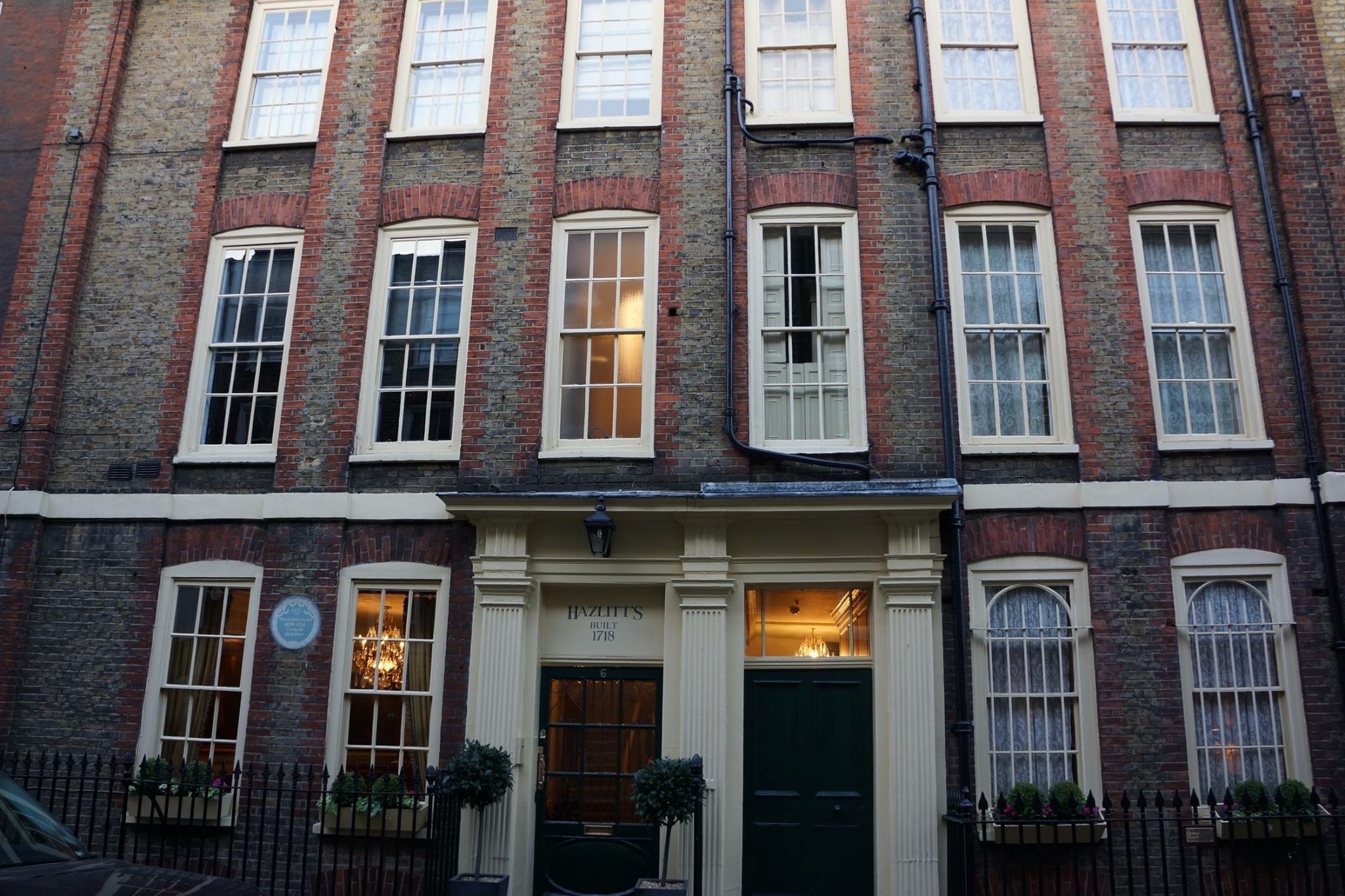
Hazlitt’s was built in 1718 on Frith Street, practically in the middle of Soho. In 1718, it was not a hotel, obviously. But the building you see today is the building that has existed on the spot since then. A beautiful old Georgian terrace of houses, three of which have been knocked together to form the core of Hazlitt’s Hotel. I cannot emphasize enough how beautiful the building is; its Georgian proportions are perfect, the brickwork is beautiful, with large Georgian sash windows for all the rooms, and a big Georgian front door, which you must ring the bell to be let in.
Once inside, you’ll be given a welcome as if you were an old friend (and the more you stay, the more they remember you). The staff are attentive. You’ll never have to carry your bags up the vertigo-inducing stairways (and there are no elevators in this hotel, where would they put one?). The common areas are designed to be warm and welcoming. You are welcome to use them throughout your stay. We’ve had guests come visit us during our stays, and they will happily lay out complimentary tea for you and your guests (and they will bring you a complimentary tea tray to your room whenever you ask for it).
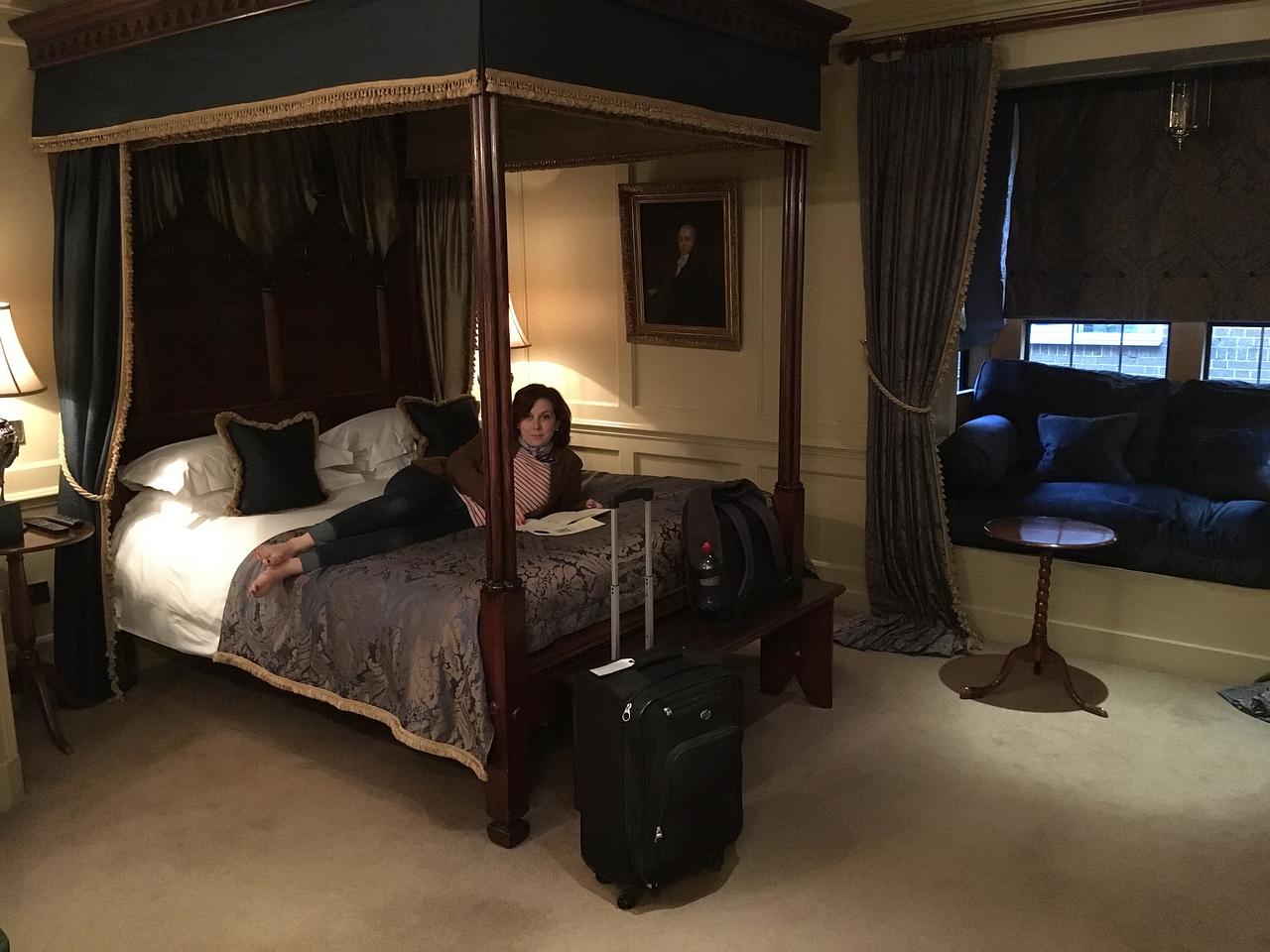
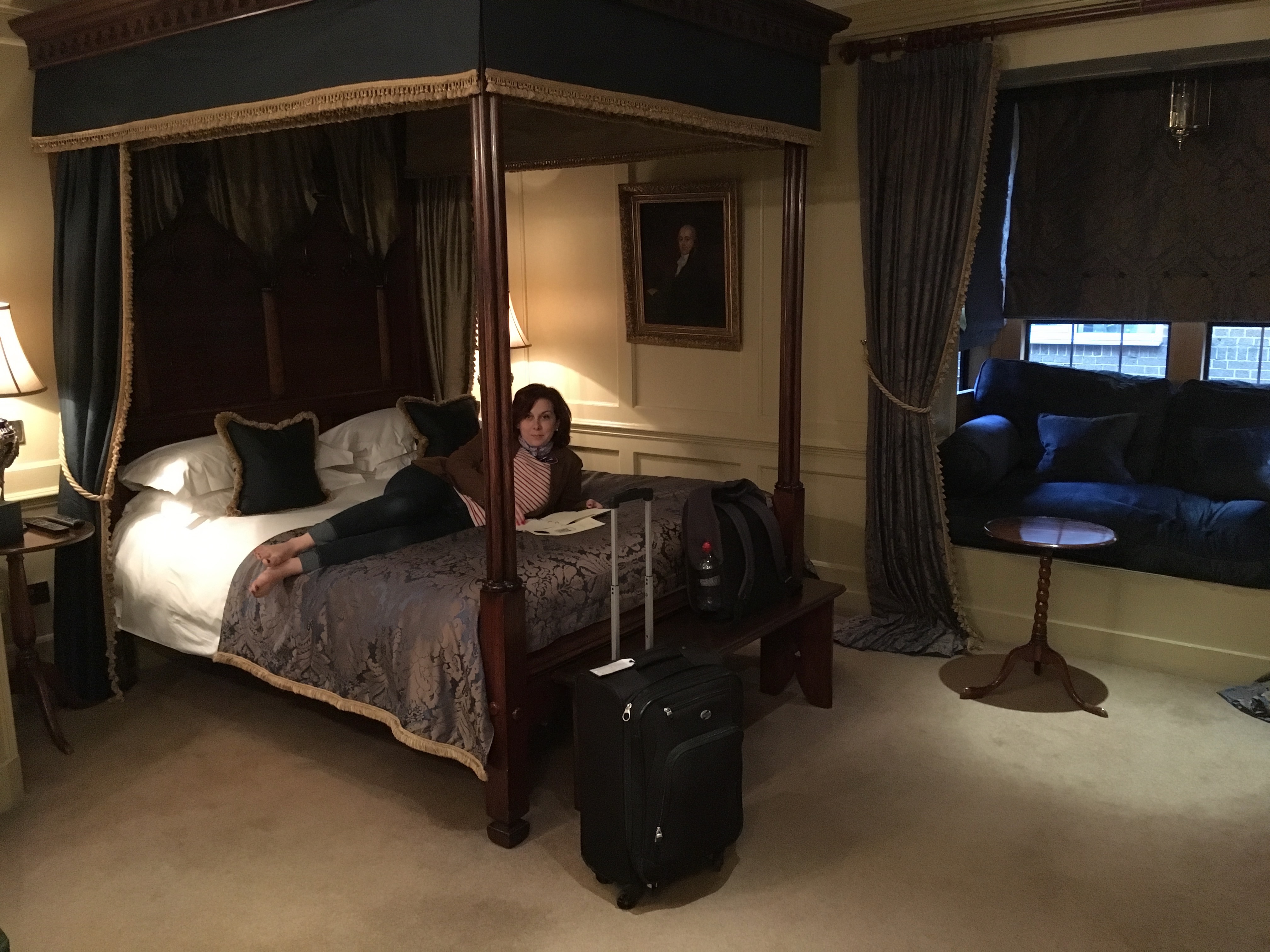
Our first stay there was perfect. The room wasn’t too much, and we got a big four-poster bed, a bathroom with a full bath, and a glorious throne of a toilet called a Thunderbox. As we explored London for the next few days, it was the perfect base for us. The staff were friendly and helpful. When we mentioned we wanted tickets to a sold-out play, the concierge managed to secure us tickets and decent seats. We enjoyed having breakfast brought to our room every morning, where we could watch BBC Breakfast, read our papers, and get ready for the day in London.
When we’d return from a day of exploring, our room would be cleaned and ready for our return. We’d often have tea again in the room, perhaps a nap. Then we’d get ready for the ‘second shift’, going off to dinner and a show for the evening, only to return to Hazlitt’s late and crash into bed. We’ve always slept well at Hazlitt’s (except for the one time our room faced out on Frith Street).
Though we were aware we were still in Soho. During one stay, our room was on the back of the hotel, and the view was Bateman’s street, basically an alleyway. During our stay there, there was a homeless couple living in a tent on the roof of one of the neighboring clubs. We felt dirty staying in our luxurious hotel, compared to what was happening behind the same building. Next door was a strip club. By far my favorite feature of the hotel is that down at the end of the block was a Nando’s. If you haven’t had Nando’s, you must go to Nando’s. They’re everywhere in Britain and are the best chicken and chips you will get anywhere. They are a welcome respite if you have jetlag, but also if you’re having a late night out and are hungry after getting out of a play or concert.
Hazlitt’s, of course, has three hundred years of history to tell. These Georgian townhouses were constructed at numbers 5, 6, and 7 Frith Street during a period when Soho was rapidly developing from fields and hunting grounds into a fashionable residential area for London's elite. The strategic location, just steps from what would become Soho Square, positioned these houses at the center of London's emerging cultural and social life. The area attracted a diverse mix of aristocrats, intellectuals, artists, and foreign émigrés, creating a cosmopolitan atmosphere that would define Soho for centuries to come.
The hotel's namesake and most celebrated resident was William Hazlitt, perhaps the greatest of all English essayists and critics. Hazlitt moved to No. 6 Frith Street in the 1820s, during the height of his literary career. William Hazlitt lived at No. 6 Frith Street, and died here on the 18th September, 1830, at the age of 52.
During his time at Frith Street, Hazlitt was at the center of London's literary world. Hazlitt knew all of the literary figures of his day, including Wordsworth, Coleridge and Southey. His great friend, the celebrated author Charles Lamb, was with him when he died. The house served as both his residence and workplace, where he penned some of his most influential essays on literature, politics, and philosophy.
Throughout the 18th and 19th centuries, the Frith Street houses served as home to numerous notable figures who shaped British culture and society, including John Snow (not the King in the North). Snow was a physician and a leader in the development of anaesthesia and medical hygiene. He is considered one of the founders of modern epidemiology and early germ theory, in part because of his work in tracing the source of a cholera outbreak in London's Soho, which he identified as a particular public water pump. It was a fashionable address for the literati of the time, and all 30 very individual rooms at Hazlitt's are named after distinguished residents and visitors to the houses (Snow’s room is my favorite).
The guest list read like a who's who of Georgian and Victorian society. Among the notable residents and visitors were Thomas Archer, the baroque architect who designed several important buildings; Sir Joseph Banks, the naturalist who accompanied Captain Cook on his voyages and later helped develop Kew Gardens; and various members of the nobility, including Baron Willoughby of Parham and the Duke of Portland.
Mrs. Newdigate, who was the first occupier of No. 5 Frith Street, ran it as a boarding house and let rooms to lodgers, one of whom was Mary Barker, a close friend of Jonathan Swift. This tradition of providing accommodation for writers, artists, and intellectuals established the area's reputation as a creative hub that continues to this day.
The preservation and restoration work undertaken by the current owners has been meticulous. It is the nature of old buildings that nothing is perfect. Wooden floors have settled so that in some rooms, it is an uphill walk to bed. Doors do not fit as snugly as they once did. Antique furniture is distorted by the central heating. Rather than modernizing beyond recognition, the hotel has embraced these quirks as part of its authentic historical character. There isn’t a straight right angle in the entire place. It’s glorious.
Hazlitt's was turned into a hotel in 1986 from the three unspoilt 18^th^-century townhouses. The transformation was undertaken by Peter McKay and Douglas Blain, who bought the property to save it from being knocked down and turned into flats. Their vision was to create something unprecedented: a hotel that genuinely captured the spirit of its Georgian origins while providing modern comforts. The founders' approach was both preservation-minded and creative. All of the houses have been restored to reflect how they would have looked over 300 years ago.
Hazlitt's has maintained its literary connections into the modern era. Hazlitt's is truly a treasure chest for lovers of literature; the hotel's library (and bookshelves dotted around the bedrooms and common parts) hold tome upon tome of classic novels and non-fiction. Many of these are pretty special, as writers who stay there often leave signed copies or first editions for other guests to enjoy.
Every room in this hotel is different, and every room is a compromise of sorts. Choosing to stay at Hazlitt’s means that you’re choosing to eschew your modern expectations of a hotel. You will not have much room (unless you pay for a suite). You might or might not have a full bathroom. If your room is facing Frith Street, you may experience noise well past midnight. Even the location is a compromise. It is not easy to get around Soho at night, even in a taxi or on foot. You stay at Hazlitt’s FOR the compromises, because what you experience is Old World London excellence that simply doesn’t exist anymore.
One of the best chapters in Roger Ebert’s memoir, Life Itself, is the chapter he dedicated to the hotel in London he stayed in for nearly 30 years before it closed. It’s an elegy for a London that no longer exists (but also paradoxically also still exists, because the definition of London is in constant change). His hotel on 22 Jermyn Street, also known as Eyre Mansion, was a 16-room hotel run by a man who thought running a hotel was just an eccentric activity you undertook and you didn’t do it to get rich. He described a hotel where you could light your own fireplace, use beaten-up old furniture of questionable provenance, and experience London almost as Dickens would have experienced it (or to give you a visual comparison, the Leakey Cauldron in Harry Potter). That hotel was closed and swept away long ago. But Hazlitt’s is still around, one of the last classic and eccentric hotels left in London. The heart of Britain lives in a hotel like this.
I’m not sure we’ll stay there again, though, on an upcoming trip. Our last visit wasn’t perfect, and while we didn’t expect perfect, there were enough problems to warrant reconsideration. First, the hotel was undergoing preservation works. We didn’t mind this much, except that there was scaffolding right outside our window and the workmen on the way managed to get an eyeful of Mrs. Anglotopia while she was taking a bath. Windows we had closed were inexplicably open again, implying work crews had been in our room when we weren’t there (we travel with expensive computer and camera equipment). And despite traveling carry-on only, we struggled to have enough space in the compact room designed for malnourished Georgians. Then there was the Soho problem.
Soho, since the pandemic, has regressed. It is much seedier now than it was when we first started staying there. More people puking on the streets. More people are shooting up in doorways. More traffic. On busy weekend nights, we could have walked faster than the taxis were able to drive us (but we wouldn’t dare walk on the open street at that hour). One taxi driver was practically angry that it cost us so much to get through the West End and Soho, apologizing profusely that he made so much money on our fare. Not to mention that, despite it being a well-known hotel, London cab drivers still do a double-take on how to get there - quite a few had to use their satnavs when the entire point of their meticulous training is that they know where everything is and how to get there, via multiple routes.
We left that stay unhappy. The staff knew it, and they comped us a night as compensation, but as we left in our hire car, we both decided that perhaps we had grown out of Hazlitt’s and would stay somewhere else next time.
But reader, we’re struggling. All the hotels in central London are pretty much the same now. Very few have actual character or history behind them anymore, unless you want to pay £1,000 a night for faux luxury in one of London’s historic hotels. Everyone is either an American chain hotel, or a European chain hotel, or a luxury hotel that offers something we can’t afford (that’s what was nice about Hazlitt’s, it was mid-grade and affordable). When I recently asked Anglotopia followers on social media for suggestions, most were characterless boxes that all looked the same (beige or grey modernist everything). I don’t want to stay in a Marriott or a Hilton or a Holiday Inn.
3 likes
Post a reply