Sunday Post: Elizabeth 100 - What the Queen Meant to Me
Editor's Note: The following is an adaptation and an update of an essay I've shared before. These things tend to have multiple lives, especially as time moves on. I'm working on a special publication to commemorate Elizabeth 100 (the upcoming 100th anniversary of her birth next week), and I decided to rewrite this and expand it to reflect on the Queen and what she meant to me, and to America, a country that defines itself as being against things like Kings & Queens. I thought that anyone who had read the previous version of this essay would enjoy seeing it turn into something entirely new. Let me know what you think!
I saw the Queen once.
That used to be a sentence I wrote in the present tense. When she was alive, it felt like a small but lucky boast — the kind of thing you could drop into conversation with a British friend and watch their face do a quiet little calculation, working out where and when and what it must have been like. Writing it now, in the past tense, is one of those small, strange adjustments that have crept into the language over the last few years, ever since the morning Huw Edwards appeared on the BBC in a black tie and I understood, before he had said a word, exactly what he was about to tell me.
But let me start with the day I saw her. That part hasn't changed.
The Mall, April 2011
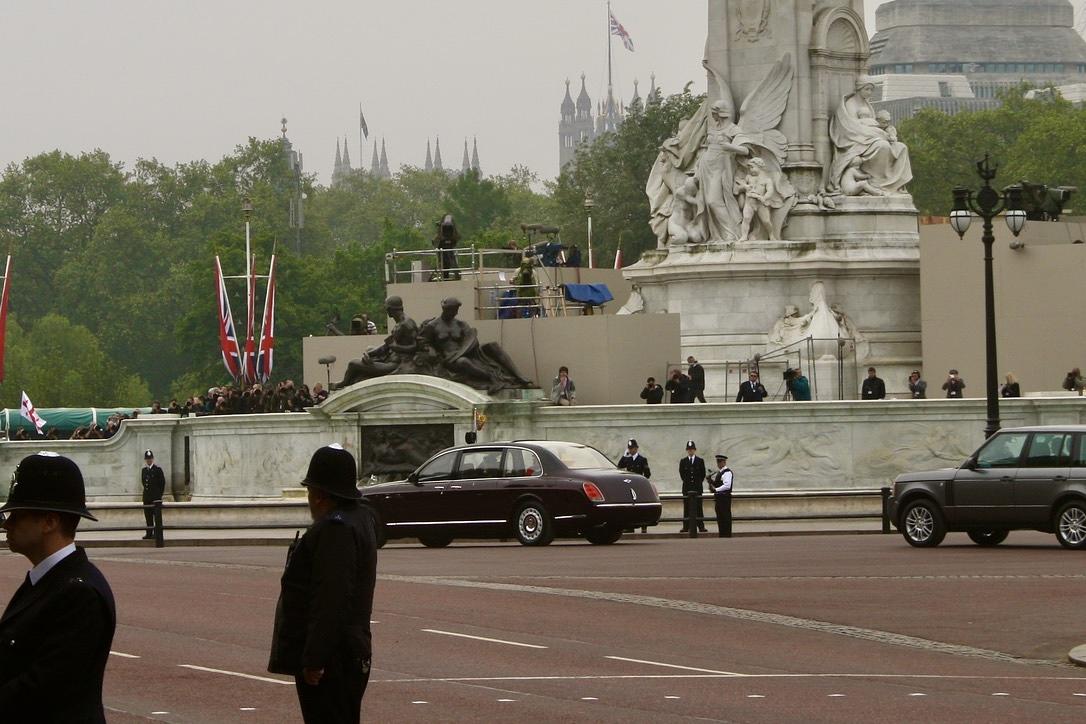
I was standing on The Mall, the stately road that runs from Buckingham Palace down to Whitehall, for the royal wedding of Prince William and Kate Middleton. I had woken up at 5:00 a.m. to get my spot. I had been lucky enough that morning to do an interview with BBC Radio from the media scrum area, so when I ducked out of the scrum, all I had to do was sidle my way to a place on the rail. I got a perfect spot.
It was a very long, boring morning until things started happening. Every slight movement on the road that might have been interesting elicited a wave of excitement from the crowd. The street sweepers doing their final passes got a cheer. A policeman adjusting his hat got a cheer. Finally, the procession of fancy Rolls-Royces and Mercedes began as they all made their way toward Westminster Abbey. I was close enough that I could clearly see the gates of the Buckingham Palace forecourt. As the ceremonies started up and the loudspeakers boomed with the preparations from inside the Abbey, the gates swung open and a scarlet Rolls-Royce eased out onto the road.
The first thing I saw was the hat.
Then I saw her.
Her Majesty, in all her understated, quietly magnificent glory. The Queen. I could see her smiling. I even managed to take a picture with my camera. And I almost teared up, right there on The Mall, an American standing among strangers to watch a woman I had never met drive past on her way to her grandson's wedding. I had no explanation for the tears, then or now. Nothing in my citizenship or my upbringing or my political philosophy had any good reason to offer them to her. They were there anyway. They have been there, for the same reason, on a few other occasions since.
It is, I have to admit, a strange thing to be an American and love the head of state of another nation. But I did. I still do, somehow, even though the head of state I loved is now the head of state I mourn.
A Monarch, Not a President
Let's face it: elected presidents are nothing compared to a monarch. When we got rid of the British king back in 1776, we set up a system that was somewhat similar, but swapped the crown for a ballot. As the years went on, despite all our founders' best efforts to avoid recreating what we had just fought a war to escape, the American presidency quietly turned into a kind of pseudo-monarchy. We project onto our presidents a lot of the feeling that Britain reserves for its monarch — the desire for a national parent a unifying figure, a living symbol of the country as a whole. The trouble is that our presidents are actively political, are in power for a few short years, and spend roughly half their tenure being hated by roughly half the country. They don't inspire affection the way a monarch does. They can't. It's not the job.
The Queen represented the entire nation of the United Kingdom and her Commonwealth realms in a way no elected official ever can. Her government, which ruled in her name, was the part that was answerable to voters, and it never enjoyed the same kind of affection she did — with the possible exception of Winston Churchill, who essentially received a king's funeral when he died, and whose premiership bookended the beginning of her reign in a way that still seems impossible to me. Think about that: her first prime minister was Winston Churchill. Her fifteenth and last was Liz Truss, a woman who was in office for forty-nine days. Fifteen prime ministers. Seventy years. The reach of that alone is mind-bending.
No, the Queen was Britain, and Britain was the Queen. That was always the deal. It was the thing that made her so difficult to replace in the imagination, and the thing that makes the present tense so difficult to use now.
The Diana Effect
As I'm roughly the same age as Prince William and a little older than Harry, I grew up in a strange generational parallel with them. My childhood mirrored theirs in the way that anyone growing up in front of a twenty-four-hour news cycle can find themselves unconsciously mirroring the childhoods of public figures the same age. Princess Diana was a huge part of my childhood, too, at one remove. My mother was an Anglophile, which meant that the Charles-and-Diana drama was always playing somewhere in the background of our house. I saw the news stories about the marriage troubles. I saw the endless photographs of their kids. When I was very young, I would always watch CNN Headline News before school, because even as a child, I loved to be informed about the day's news, and the British royal family always seemed to be part of the day's news.
It was a death that really began my fascination with the royal family.
When Diana died, I was thirteen years old. I was frankly getting tired of all the gossip. But one night in August 1997 I came home from an evening out at the local mall — back when going to the mall was still a thing that teenagers did — and I turned on the TV and saw the news that Princess Diana had died in a car accident in Paris.
I was simultaneously devastated and enthralled. It was the first really major royal event I remember witnessing through the media in real time, and I was glued to the TV for the next few weeks as the details were revealed, as the pundits debated endlessly, as the flowers piled up outside Kensington Palace, as the mood in London shifted, day by day, from shock to grief to something dangerous and hard to name. I remember the Queen making a speech from Buckingham Palace and it being a really big deal. I didn't yet understand why.
I remember watching the funeral when it happened, broadcast on American TV. I watched Prince William and Prince Harry walk behind the gun carriage that carried their mother's coffin through central London. William and I were almost the same age, and I couldn't imagine losing my mother at twelve and having to face it, at that scale, in front of the world. My final memory of that terrible time is watching Diana's hearse being driven through the rolling green English countryside with the golden late-summer sunlight overhead and the roads lined with thousands of quiet, crying people trying to pay their final respects.
I later saw The Queen with Helen Mirren many times, and it became one of my favorite films. I loved the way it showed me, retrospectively, everything I had not understood in 1997 — the tension at Balmoral, the gulf between the Queen's instincts and the country's sudden new emotional language, the slow and painful recalibration of a monarchy that had always kept its feelings private in the face of a public that suddenly refused to. The Queen made mistakes during that week. She herself, I think, always knew she had. And yet the thing that has stayed with me from Mirren's performance is the way her Queen wanted to do right by the country without knowing, at first, how to, and eventually figured out how to, and then did.
That's the Queen I loved. Not the saint that the royal PR machine sometimes wanted to present. Not a woman without failings. A very good human, doing a nearly impossible job for seventy years, and getting most of it right.
Why Americans Cared
People used to ask me, fairly often, why Americans care so much about the British royal family when we spent the better part of the 1770s fighting to be rid of them and define ourselves by being against the idea of hereditary monarchy. It's a fair question. The short answer is that we didn't quite get rid of them, not really, not in our feelings. The longer answer has a few parts.
The first part is that independence was never a 100 percent proposition. Something like thirty percent of the colonists didn't actually want independence from Britain. When the war ended, a large number of them fled to Canada, some went further afield, and many of them just stayed and quietly kept their affection for the king they had lost. That thread — the silent loyalist thread — never quite disappeared from American cultural life. It surfaces, every so often, in our strange willingness to be charmed by a throne we supposedly rejected.
The second part is ancestry. According to an Ancestry.com survey I read a few years ago, nearly seventy-two million Americans have British roots. English, Scottish, Welsh, Northern Irish. That's almost as many people as currently live in the United Kingdom. And while other ethnic groups in America — Irish Americans, Italian Americans, Mexican Americans, African Americans — have very well-defined and vocal cultural identities, Americans of British descent often don't. They are a kind of silent majority, blended so thoroughly into the default American experience that their heritage has almost become invisible to them. I think our affection for the royal family, and for the Queen in particular, is one of the few places it still shows.
My own story is American in almost every respect, but when we traced my ancestry, we found English ancestors who came from a small village in County Durham called Shincliff. It is hard to describe the feeling of standing, for the first time, in the village your great-great-grandparents left behind. They were born in a cottage in northern England and at some point decided to seek better opportunities in the New World. They gave up everything they knew and sailed across the ocean when sailing across the ocean was still a genuinely dangerous thing to do. I went to Shincliff a few years ago and felt immediately at home despite a hundred and fifty years of separation. There are a lot of Americans like me, carrying a quiet English inheritance somewhere in the back of who we are. The Queen was, for us, the embodiment of that inheritance.
The third part is the war brides. After the Second World War, something like seventy thousand British women married American servicemen stationed in the UK and crossed the Atlantic to start new lives in the United States. They brought their accents, their tea, their memories, and their loyalty to the Crown with them. They had children, and their children had children, and some of those grandchildren are reading this. Those families are still here. They watched their mothers and grandmothers cry on Coronation Day in 1953. They watched their mothers' faces whenever the Queen appeared on a BBC broadcast that had somehow made it across the Atlantic. Whole American living rooms were emotionally tuned, for decades, to a frequency being transmitted from Buckingham Palace.
The fourth part is simply that British culture, for the last several decades, has been the second most influential cultural force in the English-speaking world, after the American film and music industries. Harry Potter. James Bond. Jane Austen. Doctor Who. Downton Abbey. The Great British Bake Off. In my own childhood, it was Roald Dahl and Mr. Bean and Doctor Who. We can't get enough of the stuff. And hovering above all of that cultural export — the unspoken guarantor of it, the woman whose face was on every stamp the BBC World Service ever used — was the Queen.
She was, to put it plainly, Britain's grandmother. And I would argue that, for millions of us on this side of the Atlantic, she was also, in a strange borrowed sense, America's grandmother. We did not have a claim on her. We had no right to her. But she was there, always, in the background of our cultural and emotional lives, and we loved her for it.
The Day the News Came
When the news came, it came at the worst possible hour for me. I lived in California at the time, eight hours behind London, which meant that all the important events in British history tended to happen while I was asleep.
I had been following the story for days. The photographs of the Queen meeting Liz Truss at Balmoral on September 6, 2022, had been circulating, and something about those photographs had alarmed me. She looked frail. Her hands were heavily bruised. She was smiling, in the small, brave way she always did, but something about the image had felt final. I told my wife so. I kept telling myself I was being dramatic.
Two days later, on the morning of Thursday, September 8, I woke up and reached for my phone the way I always do, and my phone was full of alerts I did not want to read. The rest of the royal family had been summoned to Balmoral. Her doctors were concerned. I knew, the way you know when you look at a photograph of a frail parent, exactly what was happening. I turned on the BBC live feed, and I sat at my desk, and I tried to do work and waited.
And then, mid-morning California time, a news alert buzzed on my Apple Watch, about two seconds before the BBC feed cut to a man in a black tie. An Apple Watch notification, of all things, is how I learned that the second Elizabethan age was over.
I am not going to lie. I cried. It is an embarrassing thing to admit about the death of a woman who never knew I existed, on behalf of a nation whose passport I do not hold. But the tears were there, and I let them come. I was not alone. Somewhere in California that morning, I guarantee you, a lot of quiet American Anglophiles were doing exactly the same thing. Somewhere in hundreds of thousands of American kitchens, a grandmother who had come over as a war bride sixty years ago was sitting at her table with her hands around a cup of tea, and was doing it too.
There is a specific emotional quality to grieving someone you have only ever known through the mediating glass of history. You are not grieving an individual exactly. You are grieving a long, unbroken presence in your own life — the woman whose face you had seen since you were a child, the voice whose Christmas messages were always on in the background, the figure who had outlasted every American president you had ever lived through, and who, you now realized, you had been unconsciously relying on to outlast you too. It turns out she would not. It turns out nobody does.
The Thousand Small Changes
In the days that followed, I watched a country begin to change in a thousand small ways. The national anthem lost a word. "God Save the Queen" became "God Save the King," and the first time I heard Katherine Jenkins sing the new version on BBC Radio 4, I understood that this was going to take a very long time to get used to. The currency was going to change. The stamps were going to change. The post boxes, the passports, the judges' wigs, the military uniforms, the police badges. Every single place on the island where the letters E II R appeared — and there were hundreds of thousands of such places — would eventually have to be replaced with C III R.
I run a website called Anglotopia. For years, we had a category on the site called "The Queen," where every article about her went. The day after she died, I had to build a new category called “The King,” because now there was a king, and from that day forward, the content would have to flow there instead. It was the smallest imaginable editorial task, the work of maybe ninety seconds on the back end of a CMS.
Charles's first address to the nation, given that Friday evening from Buckingham Palace, surprised me. He said what needed to be said, and he said it well. "I speak to you today with feelings of profound sorrow," he began, and then he said the thing that stopped me in place: "As the Queen herself did with such unswerving devotion, I too now solemnly pledge myself, throughout the remaining time God grants me, to uphold the Constitutional principles at the heart of our nation."
I had spent years listening to commentators speculate about what kind of king Charles would be — the complaints about his letters to ministers, the worries about his political opinions, the gossip about his temperament. And then his mother died, and within forty-eight hours, he had simply stepped into the role and become the thing he had been preparing to be for seventy years. He will not be as beloved as she was. No one could be. But he will do it. The monarchy will carry on. That, in the end, is what the monarchy is for.
Permanence in an Impermanent World
Here is what the Queen meant to me, in the end.
She was permanent in an impermanent world. She was respect. She was deference. She was the embodiment, in one small woman with a handbag and a pair of sensible shoes, of an entire people and an entire continuity of history. The monarch in Britain never technically dies — the crown simply passes, instantly, on to the next person — and so the Queen is dead and the King reigns in her place and the institution itself is immortal. That, too, is the trick of it. That, too, is what makes the idea of it so powerful that even an American three thousand miles away can find himself moved to tears when the next name in the line is announced.
I used to end this essay by writing that one day I hoped to become a British citizen, and that part of the process would involve swearing an oath to the Queen, and that I would do so with all my heart. The Queen is gone now. Charles is King. The oath, when I someday get to take it, will be a king's oath instead. I will take it anyway. I will take it with exactly the same heart. The point was never the name. The point was always what stood behind the name — the long, quiet, improbable continuity of a nation represented by a single face. For seventy years, that face was hers. She wore it with grace and dignity and a kind of unshowy personal integrity that, to this American at least, made her the most impressive head of state alive in my lifetime.
When I saw her on The Mall in 2011, I had no idea that I was seeing something I would never see again. None of us knew, in 2011, how rare that glimpse would eventually turn out to be. I am glad I got the picture. I am glad I stood in the cold and the boredom of that early morning. I am glad I waited for the scarlet Rolls-Royce and the famous hat and the sudden, unmistakable profile inside the window.
Because what I was really waiting for, though I didn't know it at the time, was an entire age — the second Elizabethan age — pausing for an instant as it drove past me on a London street.
2 likes
Post a reply